All Nippon Airways’ Boeing 787 Dreamliner marked the end of its first international flight today, touching down in Hong Kong. The dreamy flying machine took off from Tokyo and arrived to what looks like quite the crowd, including some folks from Engadget Chinese, who were on-hand at Hong Kong International Airport to snap the 787 from every angle and grab some video of the pilots discussing the aircraft. Check that out after the break.
During RIM’s last quarterly results it was promised by Mike Lazaridis, co-CEO of RIM, that their new “prototype phones featuring the QNX operating system and development platform will be available in the not to distant future”. These new devices will actually run RIM’s newly branded “BBX” platform and expected to launch “early 2012″.
One of the anticipated “superphones” is rumoured to have the code-named of “Colt” and come with a hi-res 4.0+ inch touchscreen display with a single core processor (possibly dual-core). Today, additional rumoured specs have surface along with a fancy new mock-up too. Apparently the Colt will have a stainless steel bezel that’s similar to the Bold 9900 and also be thinner than the Bold 9900, which is 11 mm thin. In addition, probably its coolest feature is an “all swipe” inner bezel that will most likely gives you the ability to easily scroll through your email, web pages and music (kinda sounds like the Pre 2 “Gesture area”). Finally, there will be both a rear and front-facing camera with “enhanced flash and focus”.
Earlier this month, we found out that after a software update HTC’s Android handsets had a serious security flaw — any app could gain access to user data, including recent GPS locations, SMS data, phone numbers, and system logs. To its credit, HTC responded quickly to the security issue, and now an OTA update with the fix is going out to those on the Now Network. Sprint users with an EVO 4G, 3D, Shift 4G, Design 4G or View 4G can get the download, as can Wildfire S owners. The patch available now for a manual download, and more info on the fix can be found at the source below.
It’s old news by now, but capacitive touchscreens are a pain to use in the Winter because they can’t detect your fingertaps through a pair of gloves. But SMK has improved the design of their 6.5-inch panels so that devices like car navigation systems can still be operated if you’re driving with gloves on. More »
When we hear news about human sexual dysfunction, it often tends to revolve around men. And when female sexual dysfunction does receive attention, it’s often brought up in reference to the difficulty they face achieving sexual climax. But a new study shows that jumping the orgasmic gun is likely a problem that is faced by women and men alike—even if we don't always hear about it. More »
Android 4.0 (Ice Cream Sandwich) has been the talk of Android town, and rightfully so: it looks like the most promising version yet. But considering it doesn’t require any physical buttons, how will your phone work once it’s upgraded? More »
In the first 60 seconds of Bomb Patrol: Afghanistan, you will be hooked. You’ll then spend the rest of episode one with an elevated heart rate and your mouth open. It’s simply the most compelling thing you’ll see on TV. More »
Ever wanted to soar majestically through the clouds? Good news, freedom from your earthly ties is a 5.3-inch display and S Pen away. All that and more in the Galaxy Note ad after the break — though as we can attest, the whole creating beautiful landscapes thing isn’t quite as easy as Samsung’s simulated images make it out to be. No one ever said freedom was simple.
Lesley Goldberg The second episode of the newly renewed zombie drama sheds 600,000 viewers week-over-week but still tops “Desperate Housewives,” “The Good Wife” in the 18-49 demo.
Tenth in a series. Microsoft launched Windows XP on Oct. 25, 2001. By every measure it is the most successful Windows version ever, bringing stability to the platform, too.
Anyone can easily dismiss Windows XP, because it’s so overly familiar, having stayed long in market and so seemingly unchanged. But Microsoft accomplished much around the venerable operating system, which quickly became a stable platform for the company, too. In fact, change defined XP during its first half-decade in market, but built on the stable platform beneath. Within three weeks of the launch, Microsoft announced the Tablet PC version and Media Center Edition, then codename “Freestyle”, in January 2002.
Windows XP’s evolution should be a case study for other operating system developers. Perhaps it is; I suspect that if anyone looks hard enough they’ll see Apple copying — following with Mac OS X (and iOS derived from it) a pattern of innovation by iteration Microsoft applied to Windows XP.
Please celebrate with us a decade of Windows XP.
Microsoft then-CEO Bill Gates poses with Windows XP “gold” disc. [Microsoft]
Bill Gates signs off Windows XP gold master, Aug. 24, 2001. A helicopter waits to fly off the code. [Ari Pernick]
Windows XP boxes come off the assembly lines during simpler times. Microsoft offered only two versions of the operating system. [Microsoft]
While people wanting this disc waited until Oct. 25, 2001, XP shipped on new PCs more than a month earlier. [Priceminister]
Sign of the Times — the launch took place in New York about six week after the Twin Towers fell. Microsoft culled back its launch plans in respect to the fallen. [Nate Mook]
Bill Gates and Jim Allchin kick off the Windows XP launch event, Oct. 25, 2001. [Nate Mook]
Choir sings “America the Beautiful” during Windows XP’s launch. The song had renewed meaning for many, following terrorist attacks against the World Trade Center and US Pentagon the previous month. [Nate Mook]
Gateway gave out cows — befitting its black-and-white moo herd motif — during Windows XP’s New York launch. The direct PC maker started selling XP systems more than a month earlier. [Larry Seltzer]
Sting performs in Bryant Park, as part of Windows XP launch festivities, Oct. 25, 2001. [Tammy Loh]
About three weeks after XP’s launch, Gates unveiled Windows XP Tablet PC Edition during Comdex 2001. The first Tablet PCs debuted about a year later. Here Gates holds one during the November 2002 launch event. [Microsoft]
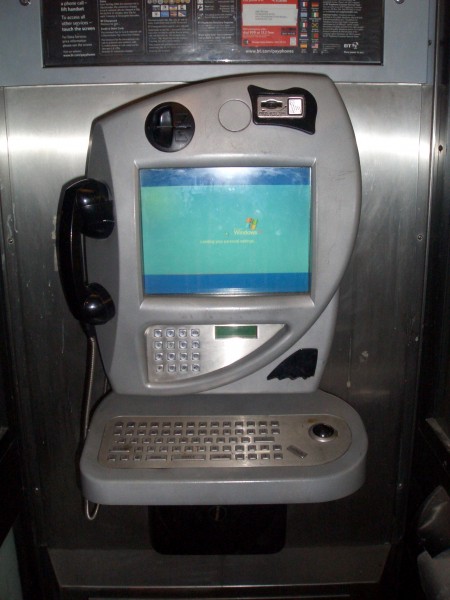
Microsoft unveiled Windows XP Embedded for ATM, cash registers and other devices on Nov. 28, 2001. Here a BT Internet payphone runs the OS.
About six weeks after Windows XP launched, Bill Gates debuted a second, media-oriented user interface codename “Freestyle”. The first Windows XP Media Center Edition PCs shipped for holiday 2002. Here Gates poses with MCE 2005, three years later. [Microsoft]
Microsoft chose actor Tom Arnold as its spokesman for Windows XP Media Center Edition, which officially launched Oct. 29, 2002. [Microsoft]
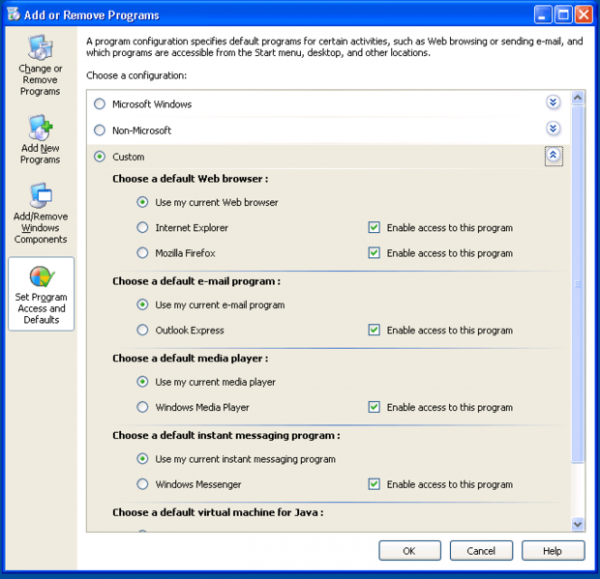
Windows XP Service Pack 1, released in September 2002, brought dramatic changes. As part of its US antitrust settlement, Microsoft agreed to provide a utility for setting program defaults for so-called middleware, like web browsing and digital media playback.
In March 2004, the European Union Competition Commission ruled that Microsoft violated antitrust laws and must release locally Windows XP sans the media player. Microsoft coyly planned to call the new version Windows XP Reduced Media Edition, but later changed this middle finger to European trustbusters to “N”. [Microsoft]
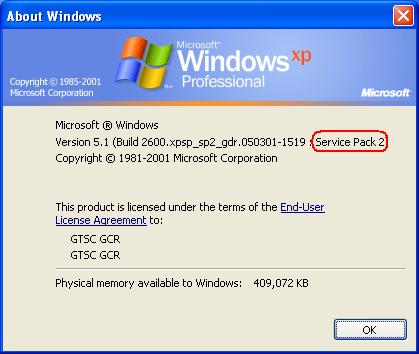
Released in summer 2004, Windows XP Service Pack 2 wasn’t just an update, it was a whole new version for free. Microsoft could have and perhaps should have released Windows XP2 instead.
Keeping with Bill Gates’ mandate that security be Microsoft’s top priority, Windows Service Pack 2 added the “Security Center”, featuring Firewall, Automatic Updates and antivirus prompts. [Microsoft],
On Aug. 11, 2004, Microsoft unveiled Windows XP Starter Edition, which two months later went into trials in Indonesia, Malaysia and Thailand. Shown here is box for the Indonesian edition. [Microsoft]
Microsoft had several Windows XP Starter Edition objectives: Increase sales in emerging markets; do so without causing pricing backlash in mature markets; and reduce piracy. Shown here is the Hindi version, which like others lacks capabilities found in full XP. [Microsoft]
Bill Gates introduces Ultra-Mobile PC, codename “Origami”, in March 2006. Microsoft provided partners with reference designs, hoping for devices selling for under $500, but the first UMPCs sold for twice as much or more. [Microsoft]
Before iPad, there was Ultra-Mobile PC. Microsoft Touch Pack for Windows XP, shown here on the Samsung Q1, offered tablet-size, touchscreen capabilities four years before Apple released iPad. [Microsoft]
From sharing photos, to collaborating on documents, to enjoying online games, web apps make the web fun, useful and entertaining. Since the beginning, Chrome has been designed to allow apps to do more, faster. Today, changes in Chrome make it even easier to access your favorite apps and discover new favorites.
In the latest stable release of Chrome, we’ve completely redesigned the New Tab page. It’s more streamlined, so it’s easier to access and organize your apps in different sections on the page. Watch the video below for a quick tour.
To add more apps to your New Tab page, click the Chrome Web Store icon. The Web Store also has a new look:
Apps and extensions are now presented in a wall of images that’s updated every time you visit the store. We hope this will help you quickly scan the store and find interesting things to try out. In addition, apps and extensions are easier to install—just hover over an image on the grid and click “Add to Chrome.”
Getting additional information about an app or an extension is just a click away. When you click on an app, extension or theme, you’ll see a panel featuring screenshots, videos and other relevant information neatly organized into separate tabs. The store also includes a brand new reviews interface that links to the Google+ profile of each reviewer. (To protect your privacy, we made sure to anonymize any reviews that you previously submitted.)
Along with the new look, a bunch of new apps have joined the store. I’m personally excited about My Robot Nation™, an app that lets you design your own robot and bring it to life with a 3D printer. There are plenty of new games to play, including The Godfather: Five Families and Fieldrunners. And for those of you still looking for a Halloween costume, check out the brand-new eBay shopping app.
We have many more features on deck, and we’re looking forward to making the app experience in Chrome even better soon.
The research folks over at ABI have some interesting news to report for Q2 2011. It appears that Android has officially passed Apple in the worldwide share of mobile apps. As of now, 44% of mobile apps belong to an Android device, while only 31% belong to an iOS device. However, ABI also made sure to point out that while Android now has a bigger market for app developers, iOS users on average actually double the amount of apps per device when compared to Android. The question I have for this study is if they considered iOS to be simply the iPhone or all iOS devices (so including the iPad and the iPod). Something tells me they only included the former, as I can’t imagine that Android is selling better than all iOS devices by a combined 2:1, but I have been wrong before. What are your thoughts on this?
Over the summer, we got word that a couple of unnamed ex-Apple engineers were getting ready to unveil an unnamed product, under the guise of an unnamed startup. As it turns out, that startup was Nest Labs, and those Apple alums were none other than Tony Fadell, longtime SVP of Apple’s iPod division, and lead engineer Matt Rogers. And yes, the product they had to share makes fine use of a click wheel.
But if you thought they’d be cooking up a next-gen music player, you’d be wrong. Instead, the pair have been designing a thermostat, of all things, dubbed the Nest. In addition to being the most stylish model ever to grace a dining room wall, it promises the kind of intelligence we’ve come to expect in other household appliances — just not thermostats, per se. It’ll go on sale next month for $249 in places like Best Buy, but we managed to snag an early sneak peek. Find some photos below and when you’re done, join us past the break where we’ll explain how it works.
Mountain View’s lawyers can collectively breathe a sigh of relief, as the FTC has accepted an earlier proposal relating to Buzz’s numerous privacy violations. The service — which alreadysettled one suit and is scheduled for rendezvous with the grim reaper — was singled out by the commission for misleading users by partially opting them in, even after they had explicitly declined to do so. As punishment, Google will be required to field yearly audits from an independent party for the next twenty years (!). Don’t mess with the law government, kids.
Android is still producing explosive numbers and showing no signs of slowing down anytime soon. According to Business Wire, in the time span of just one year, when not even yet in the tablet category, Android has quickly gained ground to claim 27% of the tablet market. That’s pretty impressive considering about this time one year ago the only contender around was the iPad. If this isn’t a clear indication that Android is here to stay and the masses continue to demand the popular OS, I don’t know what is. And with pre-orders in the vicinity of 50,000 per day for the Kindle Fire, that market share percentage is only bound to rise, and rise fast. I can only assume that with all of the diversity and hardware choices that Android offers, this is what is appealing to most consumers. Devices like the Asus Eee Pad Transformer, the Galaxy Tab 10.1, 8.9 and 7.0 Plus are but just a glimpse of the many offerings and flavors of devices and manufactures available today. What’s your take on it all? Feel free to leave a comment or two below.
Rogers launched the first Canadian Android devices back in 2009 with the HTC Dream and the HTC Magic, they called this the “Android Revolution”. Every carrier these days has at least one device that’s powered by Google’s Android OS, but many of them have at least 50% of their selection. Take TELUS for example, 12 of their 24 current smartphones are powered by Android. Rogers currently has 14 smartphones and Bell has nine. This isn’t taking into account the sub-brands and new entrants, nor the Android-powered tablets.
Perhaps Rogers was a bit premature by stating the Android Revolution occurred in 2009, because it actually feels like it happened this year. Gartner Research has pegged the Android OS to capture about 40% of the global OS market share by the end of this year. There are no specific Canadian numbers so the closest we have is a 3rd party June 2011 report from comScore. They believe that the Android OS increased its Canadian market share by 7% in the last 6-months to 19%. RIM’s BlackBerry is still the leader with 38% market share, and Apple owns 31% market share.
There’s an interesting quote by Wade Oosterman, President of Bell Mobility, in Marketing Mag that stated Android is their fastest-growing platform, and specifically in July it exceeded BlackBerry to become their biggest OS – which is probably caused by the release of the Samsung Galaxy S II and that BlackBerry didn’t release a new product until August.
“Canadian numbers aren’t available, but service providers agree the product is a sales juggernaut. Android is Bell Mobility’s fastest- growing platform, becoming its biggest smartphone operating system overall in July, eclipsing Blackberry. “By Q4, the busy holiday season for wireless, we expect Android to account for the largest volume of new activations,” says Wade Oosterman, president Bell Mobility and residential services.”
It makes sense that Android is their fastest growing platform. Microsoft’s Windows Phone hasn’t seen a new device this year, BlackBerry has only released 4 new handsets and the new iPhone 4S was just launched. New Android devices are released at various price points about a couple times a month.
This coming Q4 will see even more Android handsets get released in Canada. Over the next few weeks the HTC Amaze and Holiday, Motorola RAZR, Samsung Galaxy Nexus, Galaxy S II LTE, Galaxy S II X, Galaxy Tab 8.9 LTE, Sony Ericsson ray, LG Optimus Net and the LG Optimus LTE Eye… exciting times for the little green robot.
Jose Bautista remains the most valuable player in the American League in the eyes of baseball fans. The Toronto Blue Jays star won his second consecutive Hank Aaron Award as the most outstanding offensive performer in the AL.
Sit back and take notes while we… talk about Supernote. This note-taking app quietly debuted on the Eee Pad Transformer and Slider earlier this month, when ASUS rolled out an OTA update to Android 3.2.1, but the company has now provided substantially more details on the feature, which promises to “revolutionize the way you take notes in class.” With Supernote onboard, students can write or scribble using either the keyboard or their own fingers. That isn’t exactly enthralling, in and of itself, but what’s cool is the fact that Supernote will convert each hand-drawn item into an image, allowing users to seamlessly modify or delete their own characters as if they were typed text. The tool also makes it easy to insert graphs or charts, thanks to an “Add Annotation” option that integrates diagrams directly into your lecture notes. And, perhaps best of all, the app will even let you insert photos, meaning you can just take a shot of your professor’s blackboard and worry about understanding it later. Intrigued? Check out a demo video, after the break.


 Engadget Chinese (translation) | Email this | Comments


 Lesley Goldberg
 ![Microsoft then-CEO Bill Gates poses with Windows XP "gold" disc. [Microsoft]](http://betanews.com/wp-content/uploads/2011/10/Gates-and-XP-RTM.jpg "Bill Gates and Windows XP Gold disc")
![Bill Gates signs off Windows XP gold master, Aug. 24, 2001. A helicopter waits to fly off the code. [Ari Pernick]](http://betanews.com/wp-content/uploads/2011/10/Bill-Gates-signs-off-Windows-XP-gold-code-600x450.jpg "Bill Gates signs off Windows XP gold code")
![Windows XP boxes come off the assembly lines during simpler times. Microsoft offered only two versions of the operating system. [Microsoft]](http://betanews.com/wp-content/uploads/2011/10/Windows-XP-boxes.jpg "Windows XP boxes")
![While people wanting this disc waited until Oct. 25, 2001, XP shipped on new PCs more than a month earlier. [Priceminister]](http://betanews.com/wp-content/uploads/2011/10/Windows-XP-disc.jpg "Windows XP disc")
![Sign of the Times -- the launch took place in New York about six week after the Twin Towers fell. Microsoft culled back its launch plans in respect to the fallen. [Nate Mook]](http://betanews.com/wp-content/uploads/2011/10/Marriott-Marquis.jpg "Windows XP Billboard")
![Bill Gates and Jim Allchin kick off the Windows XP launch event, Oct. 25, 2001. [Nate Mook]](http://betanews.com/wp-content/uploads/2011/10/Bill-Gates-and-Jim-Allchin.jpg "Bill Gates and Jim Allchin")
![Choir sings "America the Beautiful" during Windows XP's launch. The song had renewed meaning for many, following terrorist attacks against the World Trade Center and US Pentagon the previous month. [Nate Mook]](http://betanews.com/wp-content/uploads/2011/10/America-the-Beautiful.jpg "America the beautiful")
![Gateway gave out cows -- befitting its black-and-white moo herd motif -- during Windows XP's New York launch. The direct PC maker started selling XP systems more than a month earlier. [Larry Seltzer]](http://betanews.com/wp-content/uploads/2011/10/Windows-XP-Moo-Cow.jpg "Windows XP Moo Cow")
![Sting performs in Bryant Park, as part of Windows XP launch festivities, Oct. 25, 2001. [Tammy Loh]](http://betanews.com/wp-content/uploads/2011/10/Sting-concert-for-Windows-XP-600x450.jpg "Sting concert for Windows XP")
![About three weeks after XP's launch, Gates unveiled Windows XP Tablet PC Edition during Comdex 2001. The first Tablet PCs debuted about a year later. Here Gates holds one during the November 2002 launch event. [Microsoft]](http://betanews.com/wp-content/uploads/2011/10/Bill-Gates-and-Tablet-PC-468x600.jpg "Bill Gates and Tablet PC")
![About six weeks after Windows XP launched, Bill Gates debuted a second, media-oriented user interface codename "Freestyle". The first Windows XP Media Center Edition PCs shipped for holiday 2002. Here Gates poses with MCE 2005, three years later. [Microsoft]](http://betanews.com/wp-content/uploads/2011/10/Bill-Gates-and-Media-Center-2005.jpg "Bill Gates and Windows Media Center 2005")
![Microsoft chose actor Tom Arnold as its spokesman for Windows XP Media Center Edition, which officially launched Oct. 29, 2002. [Microsoft]](http://betanews.com/wp-content/uploads/2011/10/Tom-Arnold-and-Windows-Media-Center-600x517.jpg "Tom Arnold and Windows Media Center")
![In March 2004, the European Union Competition Commission ruled that Microsoft violated antitrust laws and must release locally Windows XP sans the media player. Microsoft coyly planned to call the new version Windows XP Reduced Media Edition, but later changed this middle finger to European trustbusters to "N". [Microsoft]](http://betanews.com/wp-content/uploads/2011/10/Windows-XP-N-450x600.png "Windows XP N")
![Keeping with Bill Gates' mandate that security be Microsoft's top priority, Windows Service Pack 2 added the "Security Center", featuring Firewall, Automatic Updates and antivirus prompts. [Microsoft],](http://betanews.com/wp-content/uploads/2011/10/Windows-XP-Security-Center.jpg "Windows XP Security Center")
![On Aug. 11, 2004, Microsoft unveiled Windows XP Starter Edition, which two months later went into trials in Indonesia, Malaysia and Thailand. Shown here is box for the Indonesian edition. [Microsoft]](http://betanews.com/wp-content/uploads/2011/10/Windows-XP-Starter-Editon-Indonesia.jpg "Windows XP Starter Editon Indonesia")
![Microsoft had several Windows XP Starter Edition objectives: Increase sales in emerging markets; do so without causing pricing backlash in mature markets; and reduce piracy. Shown here is the Hindi version, which like others lacks capabilities found in full XP. [Microsoft]](http://betanews.com/wp-content/uploads/2011/10/Windows-XP-Starter-Edition-Hindi-600x450.jpg "Windows XP Starter Edition Hindi")
![Bill Gates introduces Ultra-Mobile PC, codename "Origami", in March 2006. Microsoft provided partners with reference designs, hoping for devices selling for under $500, but the first UMPCs sold for twice as much or more. [Microsoft]](http://betanews.com/wp-content/uploads/2011/10/Bill-Gates-UMPC.jpg "Bill Gates UMPC")
![Before iPad, there was Ultra-Mobile PC. Microsoft Touch Pack for Windows XP, shown here on the Samsung Q1, offered tablet-size, touchscreen capabilities four years before Apple released iPad. [Microsoft]](http://betanews.com/wp-content/uploads/2011/10/UMPC-600x376.jpg "Samsung Q1 UMPC")