
Air Canada has been fined $50,000 US by the U.S. Department of Transportation for violating "deceptive price advertising" rules in online ads.
Reality Bites
Air Canada has been fined $50,000 US by the U.S. Department of Transportation for violating "deceptive price advertising" rules in online ads.
Posted by Maciek Nowakowski, Associate Product Manager
When I check my email, I often rely on the message snippets to figure out which messages to open first. Sometimes, though, I want to see more than snippets, which is why I’m happy to announce that you can now preview messages in your inbox using a new feature in Gmail Labs called Preview Pane. It’s probably a very familiar layout to those of you who have used Gmail on a tablet device. We also think it’s going to work especially well if you have a larger resolution screen.

After you enable Preview Pane from the Labs tab in Gmail Settings you’ll see a toggle button in the top right corner of your message list, which lets you switch between preview and list views.


Multiple universes are accessed, in fiction, through portals in space or mystical necklaces or sometimes just in dreams, but always when characters break the rules of space time. In reality, alternate universes are not in other dimensions. They’re just far, far away. And the reason they are alternate universes is that they can’t be reached no matter what. But can they be tested for? More »

Android: Bubbleator is a utility that will slowly scroll notifications like missed calls, new SMS messages, and the latest posts from your Twitter and Facebook streams across your home screen as a live wallpaper. More »


NASA’s Mars Reconnaissance Orbiter may have just found flowing water on Mars. It’s the closest that scientists have come to finding flowing water on the Red Planet and will help determine if Mars could harbor life. More »


Gmail for mobile was looking a little tired around the eyes, so Google went ahead and gave the ol’ web app a cosmetic lift. The update, announced on the Gmail blog, packs a hat trick’s worth of tweaks aimed squarely at iOS and QNX (read: BB PlayBook) users. Email messages can now be manually refreshed with a top-down pull and release — a feature similar to Twitter’s own drag-down approach. The team also added a bit of finesse to inbox navigation with new sliding transitions, and even beefed up the graphical interface, taking full advantage of that Retina Display. Curious to see these tune-ups in action? Then head to the source for your own hands-on.
Gmail for Mobile gets a facelift, now ready for its Retina Display close-up originally appeared on Engadget on Thu, 04 Aug 2011 14:29:00 EDT. Please see our terms for use of feeds.
As part of our effort to provide an improved and consistent web experience across Google products, we’d like to invite you to try out a new look for the documents list that’s rolling out to users over the next few days. If it’s available to you, you’ll be able to preview the new look by clicking on Try the new look under the gear icon in the upper right. You’ll be able to return to the classic look using the same menu.
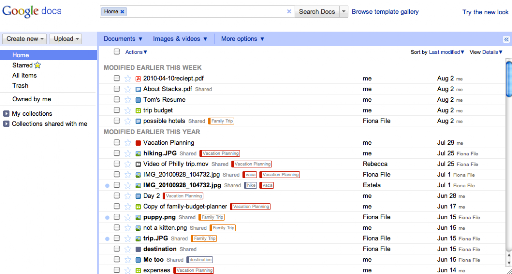

As part of this new look, we’ve also added keyboard shortcuts to help you easily navigate your documents list without a mouse. For example, when selecting a document, use the ⇓ (down arrow) to move down the list and the ⇑(up arrow) to move back up. Once you find the item you’re looking for, type a to open the Actions menu. Then, use the ⇑ and ⇓ arrow keys to navigate the Actions menu, and hit to select an action.
The Create new shortcuts are also convenient for creating new docs while you’re working. Simply hit Shift + T to create a new text document, Shift + S to create a spreadsheet, or Shift + C to create a new collection.
Can’t remember all those shortcuts? Just remember the question mark. Type ? when you’re not in the search bar, and a window will appear showing all available shortcuts.

These shortcuts will only be available if you’re using the new interface. Keep an eye out for more changes to the new interface as it evolves, and make sure to tell us what you think about the new design in this brief feedback form so we can continue to improve your experience.
Posted by: Ted Chen, Software Engineer

 Lesley Goldberg
Former showrunner Howard Gordon says “conversations are definitely happening” but he “will not be heartbroken” if it doesn’t happen.

Whether you’re an faithful Android user or you’ve just unboxed your first Android phone, there’s a wealth of free and cheap apps in the Android Market that can turn your device into a mobile powerhouse. Our second annual Lifehacker Pack for Android is stuffed full of apps to keep you connected to home, office and friends, or just help you stay entertained on the go. More »

Let’s do a roll call, shall we? Who doesn’t have a Honeycomb tablet to shill in the states? Acer, ASUS, Motorola, Samsung, Sony, and Toshiba all have something to their names, with Dell possibly bringing its China-only Dell Streak 10 Pro here too. Until now, Lenovo was one glaring exception. The company already had a head start selling the LePad tablet in China, but it was only last month that it announced not one, but two Honeycomb slates for the US market: the IdeaPad K1 for mainstream consumers, and the ThinkPad Tablet for business users (and a fair share of geeks, too). Now, we could easily roll our eyes at how saturated the market for Android tablets is becoming, but Lenovo isn’t just any old OEM. The brand has won such an avid following that we bet the company could have essentially slapped its name on a plain-Jane black slab and waited for loyal fans to line up.
In fact, though, you’re in for a bit more than name recognition. The K1 goes after mainstream consumers with a winsome design, sure, but also a software package designed to make Honeycomb easier to use, and to help ensure that flummoxed, low-tech users don’t have to spend too much time downloading apps out of the box. What’s more, it ships with Android 3.1 and has a two-cell battery that promises up to ten hours of battery life. Oh, and the 32GB model rings in $499, undercutting the 32GB iPad 2 and Samsung Galaxy Tab 10.1 by $100. But is that enough for it to stand out? Let’s see.
Gallery: Lenovo IdeaPad K1 review


Continue reading Lenovo IdeaPad K1 review
Lenovo IdeaPad K1 review originally appeared on Engadget on Thu, 04 Aug 2011 12:00:00 EDT. Please see our terms for use of feeds.
Permalink | | Email this | Comments

Getting tested for STDs used to mean a doctor’s visit, vials of blood, and days, weeks, or even months of anxiously waiting for results. mChip aims to change all that, while simultaneously ridding your brain of viable excuses not to get tested. It works as such: one drop of blood goes on the microfluidics-based optical chip, 15 minutes pass, and boom, the AmEx-sized device will confirm whether or not you have syphilis and / or HIV. The bantam gizmo is practically foolproof, as reading the results doesn’t require any human interpretation whatsoever. Plus, it’s cheap — cheaper than a coffee at Starbucks. One dollar cheap. Researchers at Columbia University claim the mChip has a 100 percent detection rate, although there’s a four to six percent chance of getting a false positive — a stat similar to traditional lab tests. As you’d likely expect, there’s hope that the inexpensive mChip will help testing efforts in places like Africa to detect HIV before it turns into AIDS. Next stop: the self-service pharmacy at CVS?
$1 chip tests for HIV in 15 minutes flat, fits in your wallet originally appeared on Engadget on Thu, 04 Aug 2011 07:32:00 EDT. Please see our terms for use of feeds.

Adding to yesterday’s five handsets, RIM’s got two more BlackBerrys for 2011 according to their MD of global sales and regional marketing, but as to whether they’ll use the PlayBook’s QNX OS remains to be seen. More »

An updated version of Skype just appeared on the Android Market sporting a crucial improvement: it now supports two-way video calling on a wide range of current Android handsets, rather than the meager four that had previously received preferential treatment. If you have a recent phone from HTC, Samsung or Sony Ericsson (excluding the Arc), then you’re probably in luck. Oh, and LG Revolution (Verizon) and Acer A5 owners can get their vogue on too. Running Gingerbread is a must, though, because Froyo will only let you use your device’s rear camera, which is obviously quite difficult to pose for. Check out the source link for the full list of supported handsets and let us know if you run into problems.
[Thanks, Nathan]
Skype two-way video chat finally arrives on more Android handsets originally appeared on Engadget on Thu, 04 Aug 2011 04:27:00 EDT. Please see our terms for use of feeds.

A suspicious device that had been attached to a Sydney teen's neck contained no explosives and appeared to be part of an elaborate extortion hoax, Australian police said Thursday.
Deep ocean searchers have found what some are calling a UFO on the ocean floor. But are there other explanations?

Rise of the Planet of the Apes hits theaters this Friday with a moving tale of genetically-altered apes who achieve human-level intelligence. But how does this film fit into the complicated time-travel tangles of the 40-year-old franchise? Let’s investigate. More »

Orgasms are supposed to be the goal of most sexual activity. Sex without one would be like watching a space opera with no giant starship battle at the end, right? But it turns out that not everybody really cares that much about the Big O all the time, because other parts of sex are giving them pleasure. More »
I have worked in the tech sector for over two decades. Microsoft and Apple have always been at each other’s throats, so when they get into bed together you have to start wondering what’s going on. Here is what’s happening:
Android is on fire. More than 550,000 Android devices are activated every day, through a network of 39 manufacturers and 231 carriers. Android and other platforms are competing hard against each other, and that’s yielding cool new devices and amazing mobile apps for consumers.
But Android’s success has yielded something else: a hostile, organized campaign against Android by Microsoft, Oracle, Apple and other companies, waged through bogus patents.
They’re doing this by banding together to acquire Novell’s old patents (the “CPTN” group including Microsoft and Apple) and Nortel’s old patents (the “Rockstar” group including Microsoft and Apple), to make sure Google didn’t get them; seeking $15 licensing fees for every Android device; attempting to make it more expensive for phone manufacturers to license Android (which we provide free of charge) than Windows Phone 7; and even suing Barnes & Noble, HTC, Motorola, and Samsung. Patents were meant to encourage innovation, but lately they are being used as a weapon to stop it.
A smartphone might involve as many as 250,000 (largely questionable) patent claims, and our competitors want to impose a “tax” for these dubious patents that makes Android devices more expensive for consumers. They want to make it harder for manufacturers to sell Android devices. Instead of competing by building new features or devices, they are fighting through litigation.
This anti-competitive strategy is also escalating the cost of patents way beyond what they’re really worth. The winning $4.5 billion for Nortel’s patent portfolio was nearly five times larger than the pre-auction estimate of $1 billion. Fortunately, the law frowns on the accumulation of dubious patents for anti-competitive means — which means these deals are likely to draw regulatory scrutiny, and this patent bubble will pop.
We’re not naive; technology is a tough and ever-changing industry and we work very hard to stay focused on our own business and make better products. But in this instance we thought it was important to speak out and make it clear that we’re determined to preserve Android as a competitive choice for consumers, by stopping those who are trying to strangle it.
We’re looking intensely at a number of ways to do that. We’re encouraged that the Department of Justice forced the group I mentioned earlier to license the former Novell patents on fair terms, and that it’s looking into whether Microsoft and Apple acquired the Nortel patents for anti-competitive means. We’re also looking at other ways to reduce the anti-competitive threats against Android by strengthening our own patent portfolio. Unless we act, consumers could face rising costs for Android devices — and fewer choices for their next phone.
UPDATE August 4, 2011 – 12:25pm PT
It’s not surprising that Microsoft would want to divert attention by pushing a false “gotcha!” while failing to address the substance of the issues we raised. If you think about it, it’s obvious why we turned down Microsoft’s offer. Microsoft’s objective has been to keep from Google and Android device-makers any patents that might be used to defend against their attacks. A joint acquisition of the Novell patents that gave all parties a license would have eliminated any protection these patents could offer to Android against attacks from Microsoft and its bidding partners. Making sure that we would be unable to assert these patents to defend Android — and having us pay for the privilege — must have seemed like an ingenious strategy to them. We didn’t fall for it.
Ultimately, the U.S. Department of Justice intervened, forcing Microsoft to sell the patents it bought and demanding that the winning group (Microsoft, Oracle, Apple, EMC) give a license to the open-source community, changes the DoJ said were “necessary to protect competition and innovation in the open source software community.” This only reaffirms our point: Our competitors are waging a patent war on Android and working together to keep us from getting patents that would help balance the scales.
Posted by David Drummond, Senior Vice President and Chief Legal Officer


For better or worse, Instagram’s taken the iOS-capturing world by storm. And if you’re wondering what our qualification for “by storm” is, well… let’s just say The Biebs blasted out his first image on the service last month. As the story goes, four young lads with a fistful of dollars and boundless imaginations started up the famed app on October 6th, 2010. Today, there’s still only four employees, but the user base has expanded just a wee bit. The outfit just saw its 150 millionth photo uploaded (shown after the break!), with the current rate clocking in at around 15 images per second. Naturally, we took the opportunity to ask one of those four what this meant for a future Android release, and while he confirmed that he had nothing to announce right away, he did mention that the (still free) iOS build is just “the beginning of what’s to come.” So, how’s about dropping a link to your favorite Instagram down in comments below? Best one wins!
Instagram hits 150 million uploads in nine months, still won’t talk about Android plans originally appeared on Engadget on Wed, 03 Aug 2011 15:00:00 EDT. Please see our terms for use of feeds.
Permalink |  Instagram | Email this | Comments

Watch the first trailer for director Chris Gorak (Right at Your Door) alien invasion flick The Darkest Hour, with Emile Hirsch facing a pack of invisible electricity-hungry aliens. In Moscow. More »

