DeathFrance 3000 About To Hit It’s Flesh Quota

While we here at Мишка are prone to posting up content having to do with bicycles from time to time, it’s rare that we ever tackle the wide world of competitive cycle racing. Considering the gruesome events that have been taking place at this year’s Tour De France however, I’ve had rethink our normal stance on the topic. A series of particularly horrifying images and videos have started to make the rounds stateside lately, that not only rule, but reveal the French Bicycle Superbowl to be a bit more grueling than we ever thought before.

The folks over at Deadspin have been keeping us Yanks up to date surrounding the events of the million mile race (that’s an estimate), by kindly focusing on all the various forms of carnage that have occurred over the past month.  Deadspin editor Barry Petchesky anointed this year’s event with the fitting nickname DeathFrance 3000 pretty early on, when rider Maxim Iglisky clipped a spectator in a yellow frock during the very first stage of the race. This small love tap eventually went on to cause a massive bicycle pile-up, which really set a pretty gnarly tone for the rest of the event. The entire tour wraps up this coming Sunday, but I’m willing to bet that it already ranks among the bloodiest.

During the 14th stage of the race, Laurens Ten Dam of the Netherlands, who can be seen at the top of the post, took a trip over his handlebars, planting his face firmly into a ditch. The resulting images produced by the incident are the stuff that nightmares are made of. Ten Dam strapped an ace bandage around his melon upon crashing, which essentially kept his mug from detaching from the rest of his skull, and saddled up for the rest of the ride, Aerosmith-style. While his vibrant blue and orange ensemble may direct your attention away from this guy’s train-wreck-of-a-face for just a moment’s time, it appears there was very little seperating the rider from a Hannibal Lecter victim.

I suppose I should also mention the car/bike that crash which eventually jettisoned a whole cadre of cyclists into a barbed wire fence. You can check out all that damage in the video and image above. I would be doing bicycle/injury enthusiasts a huge disservice if I didn’t at least quickly touch on this wreck.

Anyway, I’ve started to wonder why the Tour De France hasn’t really caught on in the ol’ U S of A. People attend Nascar races to drink beer out of coolers and watch things crash into other things, right? I don’t see why this principle can’t also be applied to bicycle racing. If this post changes the mind of one short-sighted Dale Jr. fan, then maybe I’ll have done my job.

Women’s topless court victory 20 years later

When university student Gwen Jacob removed her top to cool off on a sweltering summer day in July 1991, she unwittingly spearheaded a movement to give all women in Ontario the legal right to expose their breasts – though most still choose not to.

Lenovo ThinkPad Tablet and Keyboard Folio case hands-on (video)

Two Lenovo tablets in the same evening? Nah, it’s not the midsummer sun melting your cerebrum, but the same result just might happen after you ingest this one. True to rumors, the ThinkPad Tablet (yeah, that’s seriously the whole name) will indeed be shipping with a full-size USB port and an optional dedicated folio / case, and oddly enough, it’s that very peripheral that could set this unit apart from the masses. While it’s obviously no big chore to find a Bluetooth-enabled keyboard folio for the iPad, you probably won’t find a perfectly matching case with a tried-and-true Lenovo keyboard and a newfangled optical trackpad unless you’re ponying up for this guy. Internally, we’re looking at the same 1GHz Tegra 2 silicon as found in the more consumery IdeaPad K1, a 10.1-inch (1280 x 800) IPS display, a battery good for up to 8.7 hours of use, 1GB of RAM, 16/32/64GB of storage, 3-in-1 card reader, A-GPS, an accelerometer, ambient light sensor, front (2MP) / rear (5MP) cameras, a mini HDMI port (1080p capable!) and Lenovo’s own app launcher / app market.

In our discussions with Lenovo, it was made fairly clear that this guy was being aimed more at companies and less at consumers, but there’s absolutely nothing stopping the latter from enjoying a solid Honeycomb experience here. In fact, the ability to plug in a common mouse or trackpad (or combo device, for that matter) makes it far more useful than many of the ultraslim slates it’ll inevitably go up against. Also unique to the Tablet is a built-in active stylus, which is tailor-made to jot down highly important information cartoons in the company’s homegrown note-taking program.

The full-size USB port also puts it squarely in Eee Transformer territory, with the Keyboard Folio shown above making perfect use of it. In practice, the accessory worked beautifully, and while the $99 price tag may seem a bit steep, it’s not exactly cheap to go out and get a third-party case, keyboard and mouse. The company’s demanding $499 (and up) for it’s Android 3.1-based biz slate, with initial shipments starting today. Peek the hands-on video just after the break!

Continue reading Lenovo ThinkPad Tablet and Keyboard Folio case hands-on (video)

Lenovo ThinkPad Tablet and Keyboard Folio case hands-on (video) originally appeared on Engadget on Wed, 20 Jul 2011 00:02:00 EDT. Please see our terms for use of feeds.

Permalink   |  sourceLenovo [PDF]  | Email this | Comments

Lenovo’s Android 3.1-powered IdeaPad K1 tablet hands-on (video)

Is the next major Honeycomb tablet play seriously coming from Lenovo? Sure looks it, as the company has just taken the (final) wraps of its IdeaPad K1. For all intents and purposes, the K1 is a LePad dressed up in Android — this one’s packing a 1.0 GHz Tegra 2 chipset, a 10.1-inch (1280 x 800) capacitive touchpanel, Android 3.1, a two-cell battery (good for “up to ten hours”) and a few minor software tweaks that may or may not appeal to you. The Lenovo Launcher is the first of those, acting as a five-pane launchpad that’s completely customizable by the user, and it’s one that can even be disabled if you so choose. The other is the introduction of the Lenovo App Shop, yet another venue to suck down applications for Google’s tablet OS. The reason for its inclusion? According to reps here at the show, it’s there to provide a secure, safe haven for people to download from — the software that makes the cut here has been tested in Lenovo’s labs for stability and security, though the company did confess that certain app developers may fork over a bit of cash to have their program(s) considered for inclusion. More after the break…

Continue reading Lenovo’s Android 3.1-powered IdeaPad K1 tablet hands-on (video)

Lenovo’s Android 3.1-powered IdeaPad K1 tablet hands-on (video) originally appeared on Engadget on Wed, 20 Jul 2011 00:01:00 EDT. Please see our terms for use of feeds.

Permalink   |  sourceLenovo [PDF]  | Email this | Comments

RIM’s Senior Product Manager for the BlackBerry PlayBook departs for Samsung


This is big news. Huge actually. Ryan Bidan, Senior Product Manager at RIM, has departed the company. Bidan was part of RIM’s BlackBerry PlayBook team but has now jumped ship and joined Samsung. He’ll take on the role of  Director of Product Marketing. This was confirmed by his own Tweet stating that a “It’s official: There’s about to be another #cdnindallas”. Keith Pardy, He’s not the only one in in a high profile position to leave, RIM’s old CMO, Keith Pardy, departed in March, followed by Paul Kalbfleisch, RIM’s VP of Brand Creativity, in May. RIM recently announced they will “streamline operations” with a “headcount reduction”… so it’s not that surprising that people are leaving, just didn’t think it would be one of RIM”s main evangelists.

Source: CrackBerry

Related posts:

  1. RIM’s CMO departs for personal reasons
  2. RIM co-CEO Jim Balsillie adds CMO title to his name
  3. AdMob Founder and CEO departs Google

Microsoft Explorer Touch Mouse coming in September for $49.95

Microsoft Explorer Touch Mouse

It’s already been rather unceremoniously leaked, but now the Microsoft Explorer Touch Mouse is all sorts of official. Granted, it’s kinda tough to get excited about a mouse, but Redmond’s latest pointer is actually pretty neat. It sports BlueTrack Technology for getting your double click on while using your jeans or carpet as a mouse pad, and a haptic scroll strip that lets you feel the speed at which you’re flicking through the web. Oh, and that strip lets you scroll both horizontally and vertically — not bad for $49.95. Microsoft even claims it can last 18-months on a single set of batteries, just long enough to forget this wireless mouse even has a set of DC cells inside. Check out the extraordinarily brief PR after the break and keep those purchasing fingers holstered for now — this bad boy wont be hitting shelves till September.

Continue reading Microsoft Explorer Touch Mouse coming in September for $49.95

Filed under:

Microsoft Explorer Touch Mouse coming in September for $49.95 originally appeared on Engadget on Tue, 19 Jul 2011 15:01:00 EDT. Please see our terms for use of feeds.

Permalink   |  sourceMicrosoft Hardware Blog  | Email this | Comments

The Best Video Player for Windows [Video]

Windows users have a few good video players to choose from, and the title of “best” is hotly contested. For its great performance, high number of features, and ability to play just about anything, we recommend SMPlayer for all your video playing needs. More »


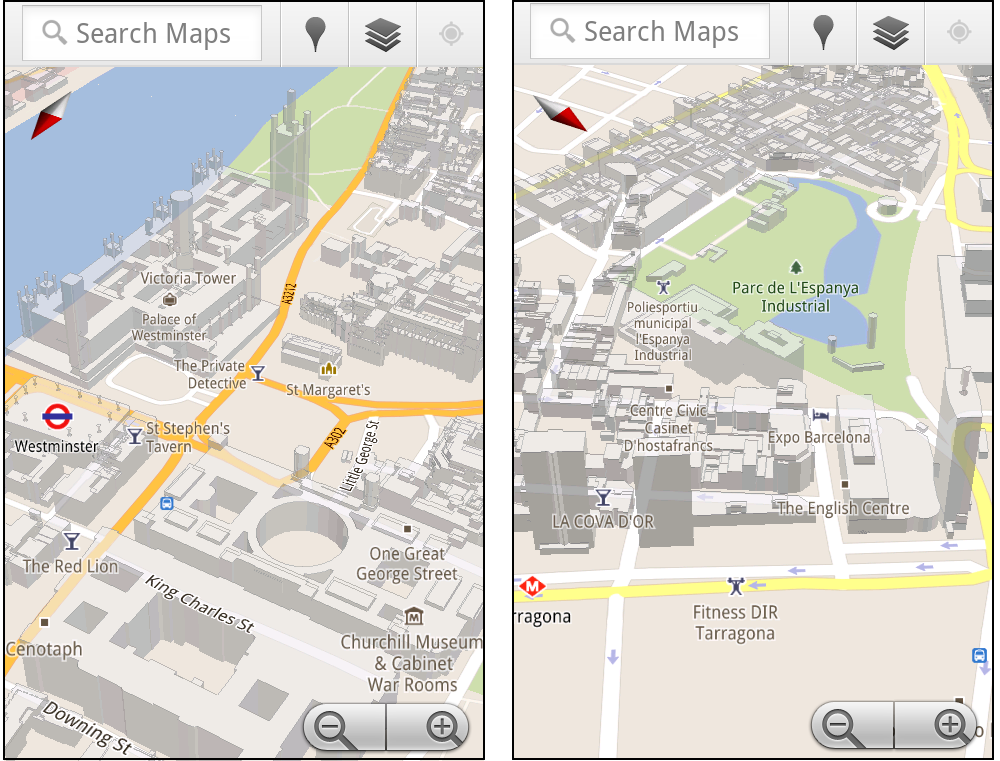
3D buildings in Google Maps for Android arise in London, Paris, Barcelona, and more

Last December, the release of Google Maps 5.0 for Android ushered in the next-generation of mobile maps where you can rotate, tilt, and zoom in and out of 3D maps. Whether you’re on the go or playing with a new phone, seeing a 3D skyline spring up in New York City, Zurich, Milan, and other cities is a helpful, fun, and unique experience–an experience we want as many of you as we can to have for your city.

We’ve been adding more cities and you will now find that 3D buildings are available in London, Paris, Barcelona, Stockholm, Singapore, Lisbon, Boulder, and 11 major cities in South Africa.

3D buildings in London and Barcelona

You don’t need to update the app, just open Google Maps for mobile on your phone with Android 2.0+ and zoom in to a city with 3D buildings. Enjoy!

Posted by Brian Brewington, Software Engineer

Google+ app for iPhone now available

Google promised that iPhone users would soon be getting a Google+ app of their own, and it’s now here. Not surprisingly, it looks a lot like the Android app, including views of your main stream and nearby users, sharing via Circles, and support for the Huddle group messaging feature. It’s not a universal app, though, so iPad users are still left out for the time being, as are those with an iPod touch, for yet reasons unknown.

Update: Google’s Punit Soni notes that there was a small issue that initially caused a test version of the app to to be served from the App Store. If you grabbed the app as soon as it was available (within the first hour and 40 minutes, specifically), you’ll likely have to re-download it to get the current version (1.0.1.1809).

Google+ app for iPhone now available originally appeared on Engadget on Tue, 19 Jul 2011 11:59:00 EDT. Please see our terms for use of feeds.

Permalink +Vic Gundotra (Google+)  |  sourceiTunes  | Email this | Comments

8 Natural Ways to Prevent a Sunburn (And Sunscreen’s Not One of Them)

beachAs summer descends upon the world, a young Primal eater’s fancy turns to playful frolicking in the sunshine. And when you’re frolicking, the last thing you want to do is slather a bunch of horrible-smelling, greasy, overpriced sunblock all over your body. It makes you slippery and imbues your countenance with a deathly pallor that is very unbecoming. If you could, you’d love to avoid the nasty practice altogether. You’d love to use more alternative methods. Methods that may not have the support of the medical community, but for which supportive research does exist. Seeing as how a common refrain throughout the newly Primal is that sunburns seem fewer and further between than ever before, I’m guessing that there’s something to it. Dietary? Supplementary?

I’ve noticed the same thing in myself and my family, so I got to wondering: what about going Primal, exactly, might be having this effect? And if something is protecting us from the sun, and it’s not just in everyone’s heads, what else can we do to bolster our natural sunblock? What can we recommend to friends and family who aren’t quite on board with the whole deal but still want protection from the sun? Let’s take a look at some potential supplements and dietary strategies. I’ll reference research as often as possible, but I’ll also draw on anecdotal experience, both personal and from the community at large.

Eat Some Lycopene

Lycopene, that famous carotenoid found in tomatoes, has been shown in a recent in vivo RCT to protect humans against sun damage. Healthy women, aged 21-47, who ate 55 g of tomato paste containing 16 mg of lycopene every day for 12 weeks experienced significant protection against acute – and potentially long term – sun damage. Remember that cooked tomatoes, and tomato products like paste and sauce, offer far more bioavailable lycopene than raw tomatoes. If you’re counting, 55 grams of tomato paste is a hair over 3 tablespoons worth.

Get Some Astaxanthin

The super-antioxidant astaxanthin is found in algae, the organisms that eat it, and the organisms that eat those organisms (like salmon, shrimp, and pink flamingo – the pink/red color gives it away). It has been getting some attention as an “internal sunscreen.” Does it stack up? Well, here’s a study on isolated human skin cells, in which astaxanthin definitely protects against UVA damage. And here’s another study on isolated skin cells showing its protective effects. But those are limited. Does the effect persist in real life settings? In other words, does ingesting astaxanthin supplements or food that contains astaxanthin offer protection from UVA? This hairless mouse study suggests that it might; astaxanthin was more effective than even retinol. I’d say it looks promising, and I’m always interested in an excuse to dine on pink flamingo thigh.

Get Some Vitamin D

A common anecdotal report is that supplementing vitamin D increases sun tolerance and protection against sun damage, and a recent study seems to confirm this. Various forms of the vitamin D prohormone offered various protections against UV damage in a mouse model: reduced sunburn, lowered incidence of tumor development. Huh, imagine that! Getting sun gives you vitamin D, which in turn protects you from too much sun. It’s funny how these things work out. Nature can be very elegant.

Get Your Long-Chain Omega-3s and Ditch the Omega-6s

A recent study out of Australia found that adults with the highest serum concentrations of DHA and EPA had the least “cutaneous p53 expression.” What’s the significance of cutaneous p53 expression? When your skin is in danger of damage from the sun, p53 expression is upregulated to protect it, and high p53 immunoreactivity can lead to melanoma. The fact that high DHA/EPA meant low p53 immunoreactivity suggests that the omega-3s were protecting the skin. And although the study’s authors noted that high serum omega-6 content didn’t seem to correlate with high p53 activity, I think a likelier explanation is this: omega-6 is so prevalent in the modern Australian diet, that even “low” levels are still above the threshold for increased susceptibility to sunburn. Going higher than that threshold won’t make things any worse, and it won’t show up in the statistics. Drop that omega-6 intake to 2% of calories, though, while getting an equal amount of omega-3s? I bet you’d see some incredible UV-resistance.

Eat Plenty of Saturated Fat

This is slightly redundant in light of the last suggestion – after all, if you’re limiting PUFAs, you gotta eat some saturated fat – but I think it’s worth mentioning. I hear about people bumping up their saturated fat intake and improving their UV-resistance all over the place, and I’ve experienced the same thing myself, but I’d never seen it mentioned in the literature. Well, here’s a cool rodent study in which mice were either given a saturated fat-enriched diet or a PUFA-enriched diet. No word on the exact composition of the two diets. When both groups of mice were injected with melanoma cells, “the initiation time required for visible tumor growth in mice receiving the polyunsaturated fat diet was significantly less than that in mice receiving the saturated fat diet.” A higher-saturated fat diet was protective, while a higher-PUFA diet was not. If you’re gonna be out in the sun, better eat your butter, palm oil, and coconut oil, eh?

Drink Tea

Tea, especially green tea, offers a complex arsenal of antioxidant compounds. How it works and what’s doing it isn’t fully understood, but it’s generally accepted that drinking green tea is a smart move and a mainstay of many healthy traditional cultures. Unsurprisingly, there’s also evidence that dietary green tea, specifically its polyphenols, inhibit the development of skin tumors by controlling inflammation and preventing DNA damage. Topical green tea extracts applied directly to the skin also offer photoprotection.

Get Some Proanthocyanidins

Proanthocyanidins, which can be found in wine and grape seeds, berries like blueberries and chokeberries, nuts like hazelnuts and pistachios, and certain niche grains like sorghum and barley, have been efficacious in preventing UV damage in hairless rodents. Whether it works for hairless apes remains to be seen, but drinking wine and eating berries sound like fine ideas regardless of their photoprotective efficacy. Actually, score one for the hairless apes who quaff wine: a recent study found that people who supplemented with grape seed extract (high in anthocyanidins) had a significantly lower risk of skin cancer. It sounds promising.

Consider Resveratrol

Resveratrol gets a lot of publicity for its possible anti-cancer, cardioprotective, and lifespan enhancing qualities, but it’s also gaining steam as a potential photoprotective agent. This study found that once incorporated into skin cells, resveratrol protected them from UV damage. Topical resveratrol seems viable, too, but I can imagine rubbing resveratrol into your sun-exposed skin would get expensive rather quickly.

Well, that’s what I came up with. I think the first four appear to be the most effective, but if you have a real problem with burning, it might be worth checking out all the strategies I mentioned. I’m also interested in what’s worked for you. Have you tried the above methods? Did they work? Fill us in and thanks for reading!

Grab The Primal Blueprint Cookbook Today and Receive Free S&H and a Free Primal Blueprint Poster

Related posts:

  1. 6 Sneaky Ways to Work Offal Into Your Diet

BlackBerry PlayBook update brings zip extraction, more storage options for attachments (updated)

RIM sure is working fast to bring its 500,000-strong BlackBerry Playbooks up to functional par. The tablet’s been on the market for three short months and is already set to receive its fourth software update. This go ’round, RIM added the ability to save attachments to a removable SD card or your phone’s internal storage, extract zip files from email (although you’ll have to use Bridge and port from your BlackBerry smartphone), a pinch-to-zoom feature for video viewing and — winner of the duh award — portrait viewing for photos. Also, the software now supports 15 additional languages — great news if you speak Galician. If you’re planning on picking up this QNX tab, you’ll receive the v1.0.7 update as part of the setup process. Current owners can wait for an update notification, or just pull it manually. So, what are you waiting for? Get downloading.

Update: And it’s gone. Seems some folks who downloaded the update were having connectivity issues using BlackBerry Bridge. RIM posted on Twitter saying users should expect a fix later this week.

BlackBerry PlayBook update brings zip extraction, more storage options for attachments (updated) originally appeared on Engadget on Tue, 19 Jul 2011 11:02:00 EDT. Please see our terms for use of feeds.

Permalink MobileBurn  |  sourceBlackBerry Blog, BlackBerry (Twitter)  | Email this | Comments