Acer planning a sliding Android tab for the holidays, won’t fit in your stocking

Acer Sliding Tab

Rumor has it that ASUS wont be the only company with a sliding Android tablet this holiday season — DigiTimes claims to have it on good authority that Acer will be launching its own 10.1-inch slate with a peekaboo QWERTY stashed behind the screen. The ARM-powered device is reportedly being manufactured by Compal, but beyond that your guess is as good as ours. By the time it lands we should be getting our first taste of Ice Cream Sandwich, but it’s a pretty safe bet if this unnamed device does ship later this year, it’ll do so with Honeycomb on board.

Acer planning a sliding Android tab for the holidays, won’t fit in your stocking originally appeared on Engadget on Thu, 30 Jun 2011 19:30:00 EDT. Please see our terms for use of feeds.

Permalink   |  sourceDigiTimes  | Email this | Comments

The New Essential Apps June 2011 [Apps]

iPhones. iPads. Android. Windows Phone 7. And even Jailbroken phones. We’ve updated all of our essential apps lists to include a few forgotten favorites, some long awaited arrivals and, as always, even more amazing apps. Check them out! More »


“I no longer believed in the idea of soul mates, or love at first sight. But I was beginning to…”

““I no longer believed in the idea of soul mates, or love at first sight. But I was beginning to believe that a very few times in your life, if you were lucky, you might meet someone who was exactly right for you. Not because he was perfect, or because you were, but because your combined flaws were arranged in a way that allowed two separate beings to hinge together.””

Lisa Kleypas (via tror)

Improved Google Search for BlackBerry 6.0 devices

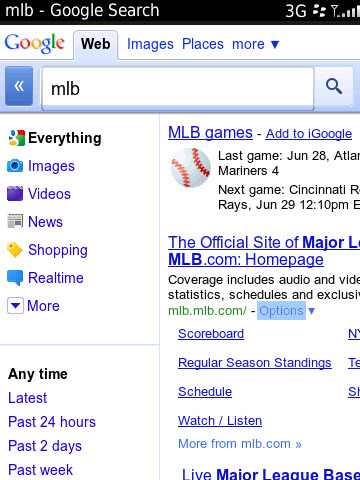
Today we’ve updated the Google search experience for BlackBerry 6.0 WebKit enabled devices. We’ve added a number of enhanced search features integrated throughout the homepage and search result pages, making searching faster and easier on www.google.com, especially on touch-enabled Blackberry devices.

Left: Improved homepage with autocomplete and search history as you type.
Right: See more information with search options and enhanced results.

  • Enter searches faster: Save time by using autocomplete and search history queries that appear beneath the search box as you type.
  • Web search: Find what you're searching for fast. Comprehensive results pages let you see relevant websites, images, videos, news, real-time results and more. Simply click on the arrow button ‘>>’ to the left of the top search box for more refinement options.
  • Image search: Swipe through image results quickly and easily on touch enabled devices. Start by selecting ‘Images’ at the top of www.google.com, then enter a search. From there, click on any image to view a larger size.
  • Local search: Find restaurants, shops and other popular business categories with a single tap. Start by selecting ‘Places’ at the top of www.google.com, then click on an icon from the Places homepage.
These features and more are available on most RIM OS 6.0+ devices with WebKit browsers like the BlackBerry Torch and BlackBerry Bold 9780, and can be accessed in 20 languages across 70 countries.

To try out the new features, go to www.google.com in your mobile browser. We recommend that you bookmark Google Search to your phone’s home screen, so that Google search is just one click away.

Posted by Ryan Doherty, Software Engineer

Sony’s S1 tablet spotted in the wild, S2 captured briefly on video

We’ve already seen press shots and teaser videos of Sony’s S1 Honeycomb tablet and dual-screen S2 (and had our eyes on them ourselves), but Germany’s Golem website managed to spend a bit of time with both of the devices at an event in Munich, and has now provided what’s surely the best look at them to date. Unfortunately, that’s still not exactly a thorough look — there’s just the single image of the S1 above, and an 18 second video of the S2, which you can check out after the break.

Continue reading Sony’s S1 tablet spotted in the wild, S2 captured briefly on video

Sony’s S1 tablet spotted in the wild, S2 captured briefly on video originally appeared on Engadget on Thu, 30 Jun 2011 16:13:00 EDT. Please see our terms for use of feeds.

Permalink Crunch Gear  |  sourceGolem  | Email this | Comments

The One Google Plus Feature Facebook Should Fear

While tech pundits are widely praising Google’s new Plus product, I’ve found the one feature that could take away from Facebook where it’s most dominant: Time on the site.

Facebook users are known for staying on the site for over half an hour a day, something no other site could compete with… until now.

To be honest, my gut reaction after using Google Plus was initially, “Why on earth would anybody switch to this from Facebook?”

However, when I loaded up Google Finance as I do every morning, I suddenly realized that I was asking the wrong question. The reality is that users won’t have the option of not using Google Plus.

Google already has more users than Facebook, over one billion. They aren’t going to suddenly leave Facebook in droves, they’re just going to spend more time on all the sites in Google’s network. That big notifications box in the top right of all Google sites is the reason why.

As I’m browsing around Google-powered sites there’s occasionally a red notification alert that pops up and immediately grabs my attention. Soon enough I’m clicking through the various notifications and seeing what my friends have shared and who has recently begun sharing with me.

It’s a not-so-subtle tactic by Google to quickly increase the amount of time you end up spending on Google properties. It’s also an easy way to immediately add social discovery to all of Google’s products.

The notifications box is also something that Google could leverage to steal one of Facebook’s most valuable assets: developers.

Something like 30 percent or more of all Facebook users’ time on the site is from applications. While Zynga, which is reportedly filing to go public this week, has built a multi-billion dollar business on top of the platform, it has little loyalty to the company.

The primary reason is that Facebook is now taking a 30 percent cut of every game developer’s business. By contrast, Google, which brings in over $30 billion in revenue each year, could easily afford to let developers keep all the money they generate.

Add in the fact that Google also has the fastest growing mobile distribution channel of any company (Android) and you suddenly realize the power that the search giant has to woo developers.

No, Google Plus is not a “Facebook killer,” but despite the company’s numerous failed attempts at getting into social media, the new Plus product gives users no other option but to accept the fact that Google is becoming exactly that: social.

This is clearly just the start, though. Once Google Plus becomes stable and more widely used, the company will attempt to compete with Facebook where it matters most by building an entire social platform. The notifications are just one indicator of what lays ahead.

Readers, have you tried Google Plus yet — do you think it has the potential to cut into your use of Facebook?

Disclosure: I own shares of Google.

Update
Looks like I was dead on with the platform prediction … there’s now code already showing their interest in launching games within the system.

Google+ for Android app (hands-on)

Given the number of apps Google’s made available for smartphones, it shouldn’t be much of a surprise that it’s taken its suite of social networking services direct to the mobile world as well. As soon as Google+ was officially announced, an app was ready for download in the Android Market and a web app became available for Safari for iOS (with its full offering to the App Store coming soon). As usual, we couldn’t resist the urge to play around with it, but how does the mobile iteration fare against the competition? Continue past the break to get a peek of the larger-than-life service squeezed into a 4.3-inch (or smaller) display.

Continue reading Google+ for Android app (hands-on)

Google+ for Android app (hands-on) originally appeared on Engadget on Thu, 30 Jun 2011 09:35:00 EDT. Please see our terms for use of feeds.

Permalink   |   | Email this | Comments

Skype 2.0 brings two-way video calling to Nexus S, Desire S, Xperia Neo and Xperia Pro

The latest update to Skype’s Android application has just been rolled out and a big part of its goodie delivery is two-way video calling. Only a quartet of phones are supported right now: Google’s own Nexus S, HTC’s Desire S, and the Xperia Neo and Pro from Sony Ericsson, all handsets that shipped with Android 2.3 installed. We suspect the rest of the Android world won’t be far behind — Thunderbolt users will surely be wondering why they’re not included in this first batch — but for now it’s just that fearsome foursome. Also included in Skype v2.0.0.45 is a UI overhaul and support for SMS messaging, neither of which suffers from any handset restrictions. Hit up the Android Market on your phone (the web Market still lists version 1) to get at the latest software.

[Thanks to everyone who sent this in]

Update: We’ve just spent a little quality time with Skype 2.0 and its newfangled video calling. Notably, we couldn’t get a video call to work between the Xperia Neo and a desktop version of Skype (update: video chat between the Skype Android app and the desktop client has since been confirmed to work; thanks, David!) — it was only possible to get video when calling between the Neo and the similarly compatible HTC Desire S. Once we did establish a connection, though, frame rates were smooth and buttery and the UI is simple and unintrusive yet offers quite a few functions. You can mute the call, choose between the front- or rear-facing camera, reposition the small window that shows your video feed anywhere on the screen, or — with a double tap upon that window — switch focus so that your own video output dominates the screen and your buddy’s feed is relocated to the smaller preview. It’s a great looking implementation of video calling, though we did only test it over WiFi, 3G performance may be materially worse.

Update 2: Skype’s press release and demo video can now be found after the break.

Update 3: Though you might suspect otherwise given the Nexus S’ inclusion, Skype has now confirmed that the Nexus S 4G isn’t supported just yet — it will apparently be brought into the fold with the next release.

Continue reading Skype 2.0 brings two-way video calling to Nexus S, Desire S, Xperia Neo and Xperia Pro

Skype 2.0 brings two-way video calling to Nexus S, Desire S, Xperia Neo and Xperia Pro originally appeared on Engadget on Thu, 30 Jun 2011 05:21:00 EDT. Please see our terms for use of feeds.

Permalink   |  sourceSkype Blog  | Email this | Comments

IBM develops ‘instantaneous’ memory, 100x faster than flash

You’ve got to hand it to IBM’s engineers. They drag themselves into work after their company’s 100th birthday party, pop a few Alka-Seltzers and then promptly announce yet another seismic invention. This time it’s a new kind of phase change memory (PCM) that reads and writes 100 times faster than flash, stays reliable for millions of write-cycles (as opposed to just thousands with flash), and is cheap enough to be used in anything from enterprise-level servers all the way down to mobile phones. PCM is based on a special alloy that can be nudged into different physical states, or phases, by controlled bursts of electricity. In the past, the technology suffered from the tendency of one of the states to relax and increase its electrical resistance over time, leading to read errors. Another limitation was that each alloy cell could only store a single bit of data. But IBM employees burn through problems like these on their cigarette breaks: not only is their latest variant more reliable, it can also store four data bits per cell, which means we can expect a data storage “paradigm shift” within the next five years. Combine this with Intel’s promised 50Gbps interconnect, which has a similar ETA, and data will start flowing faster than booze from an open bar on the boss’s tab. There’s more detailed science in the PR after the break, if you have a clear head.

Continue reading IBM develops ‘instantaneous’ memory, 100x faster than flash

IBM develops ‘instantaneous’ memory, 100x faster than flash originally appeared on Engadget on Thu, 30 Jun 2011 00:01:00 EDT. Please see our terms for use of feeds.

Permalink   |   | Email this | Comments

Samsung Galaxy S II gets official for Canada on Bell, Virgin Mobile and SaskTel

We’ve already had some indication of where and when the Galaxy S II would land in Canada, and three carriers have now finally made things fully official (even if they haven’t yet got completely specific). That includes Bell and Virgin Mobile — neither of which are confirming a price at the moment — plus regional carrier SaskTel, which plans to offer the phone for $79.99 on a three-year contract. SaskTel and Virgin Mobile both also say that the phone will be available in the coming weeks, while Bell isn’t offering much more than a chance to win the phone in a contest that ends July 19th — we’ve previously heard that the phone will be hitting Bell on July 14th. Perhaps not surprisingly, it’s looking like the phone will also alternatively be known as the “Galaxy S II” or “Galaxy S II 4G” depending on the carrier.

Samsung Galaxy S II gets official for Canada on Bell, Virgin Mobile and SaskTel originally appeared on Engadget on Wed, 29 Jun 2011 19:57:00 EDT. Please see our terms for use of feeds.

Permalink Android Community  |  sourceBell, Virgin Mobile, SaskTel  | Email this | Comments

HP TouchPad review

As things get older they tend to get bigger. It’s the same for people, corporations, models of cars, budget deficits… and so it is for webOS. As Palm was in the process of being subsumed its great mobile operating system was being eyed for much broader things, far bigger than the little phones it had previously been flashed on. Things like printers and desktops and laptops, but for its first proper foray outside of a phone it has a tall task: compete in the brutally vicious tablet space.

Its weapon is the TouchPad, a 9.7-inch tablet from HP that got official back in February and will be available July 1st (if you don’t manage to find it earlier) — $499.99 for the 16GB model, $599.99 for 32GB. That’s exactly on parity with the WiFi iPad 2 and Galaxy Tab 10.1, current kings of the tablet court. Does this plus-sized Palm progeny really have what it takes to hang at that price point, or is this just a chubby pretender that’s outgrown its britches? Read on to find out.

Continue reading HP TouchPad review

HP TouchPad review originally appeared on Engadget on Wed, 29 Jun 2011 18:55:00 EDT. Please see our terms for use of feeds.

Permalink   |   | Email this | Comments

Cisco Cius Android tablet hands-on (video)


In the market for a $750 Android tablet with an IT-controlled closed ecosystem, Atom processor, and a requisite middle man to place your order? Then you probably work for a corporation. Cisco’s Cius Android tablet was designed with a Cisco infrastructure in mind, focusing heavily on security and integration with other products. Sure, you can watch HD video or play Angry Birds (if IT is willing to flip the switch on game downloads), but you’ll mostly be using the Cius to join WebEx presentations, TelePresence conferences, and access custom enterprise apps — this is not the tablet to give your kids, for someone just looking to browse the web, or really for anyone not working at a company that already depends heavily on Cisco services. Basically, if a Cius magically appears on your desk one day, you’ll know it’s right for you.

Today Cisco launched AppHQ, a custom app store created to give IT departments complete control over device app loading, allowing them to limit access only to enterprise apps, or the entire Android Market. We went hands-on with the tablet and AppHQ at the company’s offices in NYC, and were impressed with the tablet’s ability to integrate seamlessly with Cisco services. Even though Cius isn’t intended to be used for entertainment, it’s designed to be both your primary portable device and desktop workstation — so that ability to play HD video will definitely come in handy. You can access all of Cisco’s popular communications tools, making private calls as you walk, joining a video conference from the train over AT&T or Verizon LTE, and then slipping the device into its dock once you reach the office, which adds speakerphone functionality, three USB ports, video out, and even Ethernet connectivity. You can use Cius to access an offsite virtual Windows desktop, using a mouse, keyboard, and monitor to control your primary machine. The tablet has begun rolling out to some clients and will be available worldwide on July 31st. You’ll need to reach out to your Cisco sales rep to make a purchase, but jump past the break for a quick look in our hands-on video.

Continue reading Cisco Cius Android tablet hands-on (video)

Cisco Cius Android tablet hands-on (video) originally appeared on Engadget on Wed, 29 Jun 2011 17:24:00 EDT. Please see our terms for use of feeds.

Permalink   |  sourceCisco  | Email this | Comments

HP confirms it’s in talks about licensing webOS, Samsung tipped as a possibility

HP CEO Leo Apotheker has already indicated that he’s totally open to licensing webOS to other companies, and he’s now confirmed that HP has, in fact, been in talks with a “number of companies” about that possibility. Not surprisingly, he didn’t get much more specific than that, and went some way to dampen expectations a bit, saying that “there is no time pressure to do this.” According to Bloomberg, however, “three people with knowledge of the discussions” say that Samsung is one of the companies HP has had talks with, and one said that the company is specifically interested in possibly using webOS for its Galaxy Tab tablets. HP’s Jon Rubinstein also dished a bit more on the subject to This is my next, noting that “if someone wants to really invest, and potentially help develop webOS, we’re interested in talking to them,” although he went on to indicate that HP isn’t interested in playing second (or third) fiddle with a company primarily focused on Android or Windows Phone — it’d seemingly have to be webOS first, but not necessarily webOS exclusively.

HP confirms it’s in talks about licensing webOS, Samsung tipped as a possibility originally appeared on Engadget on Wed, 29 Jun 2011 15:18:00 EDT. Please see our terms for use of feeds.

Permalink   |  sourceBloomberg  | Email this | Comments