Moneta Onyx phase-change memory prototype can write some data 7x faster than traditional SSDs


As file sizes for many data types continue to grow, smaller chunks are also becoming more ubiquitous, particularly on social media sites like Twitter and Facebook, and search tools like Google. These high-volume, small-size blocks of data may soon be served up from a specific type of SSD, like the Moneta Onyx prototype developed by a team at the University of California, San Diego. Onyx uses phase-change memory (PCM), which can rewrite single bits of data (1s and 0s) on demand, rather than rewriting data in larger chunks, yielding sustained 327 megabyte per second (MB/s) reads and 91MB/s writes with smaller file types — two to seven times faster than the most efficient commercial SSDs. PCM specifically benefits granular data, rather than large files that must be transferred completely (like photos and documents), so the tech is more likely to appear on devices serving up short text-based messages. Traditional SSDs can write larger files faster than the Onyx prototype, though the new drive offers speedier read speeds across the board. It’ll be at least a couple years before PCM becomes commercially available, but once (and if) it does, you’ll be reading about your coworker’s breakfast or college buddy’s traffic jam milliseconds faster than before.

Moneta Onyx phase-change memory prototype can write some data 7x faster than traditional SSDs originally appeared on Engadget on Mon, 13 Jun 2011 14:39:00 EDT. Please see our terms for use of feeds.

Permalink MIT Technology Review  |  sourceUCSD  | Email this | Comments

Kobo eReader Touch Edition review

When it first announced the launch of its eReader Touch Edition late last month, Kobo referred to itself again and again as the "David" in a reader market full of "Goliaths." It's not difficult to see why — the company's chief competition in the space is Amazon, Barnes & Noble, and Sony, all giants in their respective fields. In spite of overwhelming odds, however, Kobo has managed to stay afloat, and even competitive. True to form, however, Barnes & Noble launched its own device a mere day after Kobo, which for most intents and purposes, looks an awful lot like the eReader Touch Edition. In fact, the devices were seemingly so alike that we created a head to head, in order to see for ourselves precisely what set them apart.

The new Nook also managed to beat Kobo’s device to market, offering a more than worthy competitor to Amazon’s latest. The question with the launch of the Kobo then, is not only whether the David can compete in a market so dominated by the Kindle, but if the eReader Touch Edition has enough to set it apart from the superficially identical Nook.

Continue reading Kobo eReader Touch Edition review

Kobo eReader Touch Edition review originally appeared on Engadget on Mon, 13 Jun 2011 14:00:00 EDT. Please see our terms for use of feeds.

Permalink   |   | Email this | Comments

Report: Facebook IPO could reach $100 billion in value

When and if Facebook decides to sell its stock shares to the public, the value of the social networking company could be pretty massive. CNBC reports via unnamed sources, that the company founded by Mark Zuckerberg could launch its public stock offering in the first quarter of 2012. If that…

YouTube subtly adds HD preview images, logoless playback option

It ain’t nearly as monumental as the day that YouTube actually started supporting high-def videos, but it’ll certainly make those who routinely upload HD content a bit happier. We’re talking about two new additions put forth by the YT team: HD preview images and a logoless playback option. Any new video uploaded to the site in a resolution of 480p or higher will have an HD preview image wherever the player is embedded, and we’re told that preexisting HD videos will be updated “in the next few weeks.” Moving right along, that pesky YouTube watermark (seen above) will be no more should you choose to nix it, but it’s not as simple as just ticking a box; you’ll need to add “?modestbranding=1” at the end of the video URL in order to make it disappear. So, celebratory drinks at noon?

YouTube subtly adds HD preview images, logoless playback option originally appeared on Engadget on Mon, 13 Jun 2011 12:49:00 EDT. Please see our terms for use of feeds.

Permalink The Inquirer  |  sourceYouTube Blog  | Email this | Comments

Daughter Could Get Mom’s Uterus In World’s First Womb Transplant [Medicine]

A mom and daughter are poised to make medical history – the daughter, born without a uterus, could receive her mother’s as a transplant. Sara Ottoson, 25, has the rare Mayer Rokitansky Kuster Hauser (MRKH) syndrome, meaning she was born without some parts of her reproductive system. To help her have kids, doctors in her native Sweden are considering removing the uterus from her 56-year-old mom, Eva, and transplanting it into Sara’s body. [Read more via Jezebel] More »

HP reportedly in talks with major labels over cloud-based service

We’ve already seen some rumors of a cloud-syncing music store for the HP TouchPad, not to mention talk of “Music Synergy,” and it now looks like there could be some more movement on that front. According to Billboard.biz, HP’s discussions with the major record labels about a cloud-based service of some sort are now “heating up,” although that apparently doesn’t mean an actual launch is imminent. One major label exec told Billboard that the service could be “something like Qriocity for a variety of media, which can be delivered on any HP device,” but added that “we don’t know how serious they are,” which isn’t exactly an encouraging thing to hear. That uncertainty was echoed by other unnamed sources, who were reportedly unsure about how quickly HP could launch such a service (at least six months away, according to some), while one other said that HP is still “trying to narrow down what their service will look like.”

HP reportedly in talks with major labels over cloud-based service originally appeared on Engadget on Mon, 13 Jun 2011 12:23:00 EDT. Please see our terms for use of feeds.

Permalink   |  sourceBillboard.biz  | Email this | Comments

ASUS to ship 300,000 Eee Pad Transformers in June, surpass all non-iPad tablet sales


ASUS has had a hard time meeting demand for its Eee Pad Transformer since the device’s launch earlier this year, but we clearly don’t have component shortages to blame. Jerry Shen, the Taiwanese company’s CEO, says that he expects to sell 300,000 of the tablets this month, following shipments totaling 400,000 in April and May. That figure puts the device in the number two spot for worldwide tablet shipments, just behind the prevailing iPad 2. At that rate, ASUS’s latest hybrid will bring in NT $2.5-3 billion (approximately $86.6-104 million), accounting for 10 percent of the company’s total revenue for June — a figure which could increase after sales pick up in Europe and mainland China in Q3. As for North America, it looks like e-tailers are finally able to maintain inventory of the $399 (16GB) flavor — it’s listed as in stock with major sites, including Amazon and Best Buy.

ASUS to ship 300,000 Eee Pad Transformers in June, surpass all non-iPad tablet sales originally appeared on Engadget on Mon, 13 Jun 2011 11:54:00 EDT. Please see our terms for use of feeds.

Permalink   |  sourceTaiwan Economic News  | Email this | Comments

TELUS slashing international roaming rates June 27th by 60%


Last week TELUS stated they’ll be slashing their international roaming rates by over 50%, according to Brent Johnston, TELUS VP of Mobility Marketing, this “still allows us to be profitable”. Today, TELUS noted that effective June 27 the drop has actually come in at 60%. It’ll be interesting to see if Bell and Rogers follow.

For Western Europe, Mexico, Oceania the voice drops to $1.50/minute (savings of 25-50%), and data goes to $10/MB (60% savings). For the Middle East, Caribbean, Latin America, China, India and Africa the voice drops to $2.50/minute (17-38% savings), plus the data falls to $10/MB (60% savings).

TELUS’ CMO David Fuller said the Rogers monopoly of international roaming rates ended in 2009 with their HSPA+ network launch. “After the launch of our new HSPA+ wireless network in late 2009, TELUS was able to offer our customers a true international roaming capability for the first time, ending Rogers’ monopoly in international roaming for Canadians. We quickly started working with carriers around the world to negotiate reduced roaming rates for our customers and we now want to make it as simple and affordable as possible for our customers to use their smartphones wherever they go, without coming home to a surprise on their bill”.

Good savings to start the Summer.
Source: CNW

Related posts:

  1. TELUS to drop data roaming rates by 50%
  2. Rogers reducing pay-per-use U.S. data roaming rates July 12th
  3. Virgin Mobile lowers International and U.S. Data data roaming rates

Fits.me imitates ladies of all shapes and sizes, tries clothes on for you (video)

Fits.Me Female FitBot

Unless you’re in the rather strange habit of going to stores, trying on clothes, and returning home to purchase them online, you never know how they look on you until the package arrives on your doorstep. Last year Fits.me tackled this little niggling e-commerce issue with a shape-shifting male mannequin and finally, after a year of tireless work, the fairer sex has its own FitBot — turns out the female form is much more difficult to replicate. Again, the adjustable, human stand-in is making its debut at the British retailer Hawes & Curtis and our more womanly readers can head to the source to get a better idea of how the White Hipster Shirt would drape across their particular body type simply by moving a set of sliders. But, before you go, check out the pair of videos after the break.

Continue reading Fits.me imitates ladies of all shapes and sizes, tries clothes on for you (video)

Fits.me imitates ladies of all shapes and sizes, tries clothes on for you (video) originally appeared on Engadget on Mon, 13 Jun 2011 10:44:00 EDT. Please see our terms for use of feeds.

Permalink The Next Web  |  sourceHawes & Curtis  | Email this | Comments

June 13, 1983: Pioneer 10 Leaves the Inner Solar System

In the world of space probes, Pioneer 10 is a bit of a marvel having outlived it’s mission and working ten times longer than NASA ever anticipated.

Originally intended to communicate with NASA for roughly 2 years (long enough to collect information about our solar system) Pioneer 10 continued to transmit data back to Earth for decades–until 1997 when the signal became weak enough that it could no longer transmit usable data . After 1997 the probe was used by the Deep Space Network to practice locating deep space radio signals. The last contact with Pioneer 10 was January 23, 2003. Currently the probe is drifting towards the star Adebaran in the constellation Taurus and will arrive there is roughly two millions years–carrying a set of gold plates depicting life on earth.

Pioneer 10 [via Wired]

How to Clean Your Filthy Keyboard in the Dishwasher (Without Ruining it) Learn How to Make HDR Images in Photoshop or GIMP With a Simple Trick How To Wirelessly Access Network Shares from Your iOS Device

Toshiba Thrive pre-order now live, starts at $430 and ends up in your hands in mid-July

As promised, Toshiba is marking June 13th with pre-order availability of its Thrive Android (3.1!) tablet, a device whose life aspiration and name happen to coincide perfectly. This 10-inch Tegra 2 portable has the usual 1280 x 800 resolution, dual cameras (5 megapixel on the back, 2 megapixel up front), a gigabyte of RAM, and a 23WHr battery, but it also brings nice expandability with full-size HDMI, USB 2.0 and SD card slots. The Easy Grip back covers can be swapped — which, yes, means you can also replace the battery — though you’ll have to splash out $20 for any non-black hues. The 8GB Thrive costs $430, followed by the 16GB unit at $480 and the 32GB option at $580. You can order yours directly from Toshiba or at Amazon, Best Buy or Office Direct, with deliveries slated for mid-July.

[Thanks, Matthew]

Toshiba Thrive pre-order now live, starts at $430 and ends up in your hands in mid-July originally appeared on Engadget on Mon, 13 Jun 2011 05:13:00 EDT. Please see our terms for use of feeds.

Permalink   |  sourceToshiba  | Email this | Comments

Samsung Galaxy Tab 10.1 Review: The Sleekest Honeycomb Tablet

I remember standing in the audience of Samsung's CTIA press conference as it announced, for the first time ever, pricing and availability of its unreleased Galaxy Tab 10.1 and 8.9 before shipping. The smartphone (and early tablet) industries have gone this long without having to really compete based on price, mostly because in North America the carriers subsidize much of the cost. If every device costs $199 under contract, why get carried away with details like how much it actually costs?

The Galaxy Tab however was playing in a different space. While Apple ultimately caved to the pressures of carrier subsidies with the iPhone, the iPad remains completely unsubsidized and its followers buy it by the millions. The magical price point is $499 and it was at Samsung's CTIA press conference that it announced it would be matching Apple's $499 price point, and even dropping slightly below it for the 8.9-inch version.

At the time it seemed like a bold move, enough to give Honeycomb the fighting chance it needed. The Galaxy Tab would be thinner and lighter than the iPad 2 but competitively priced as well. This wouldn't be another Xoom.


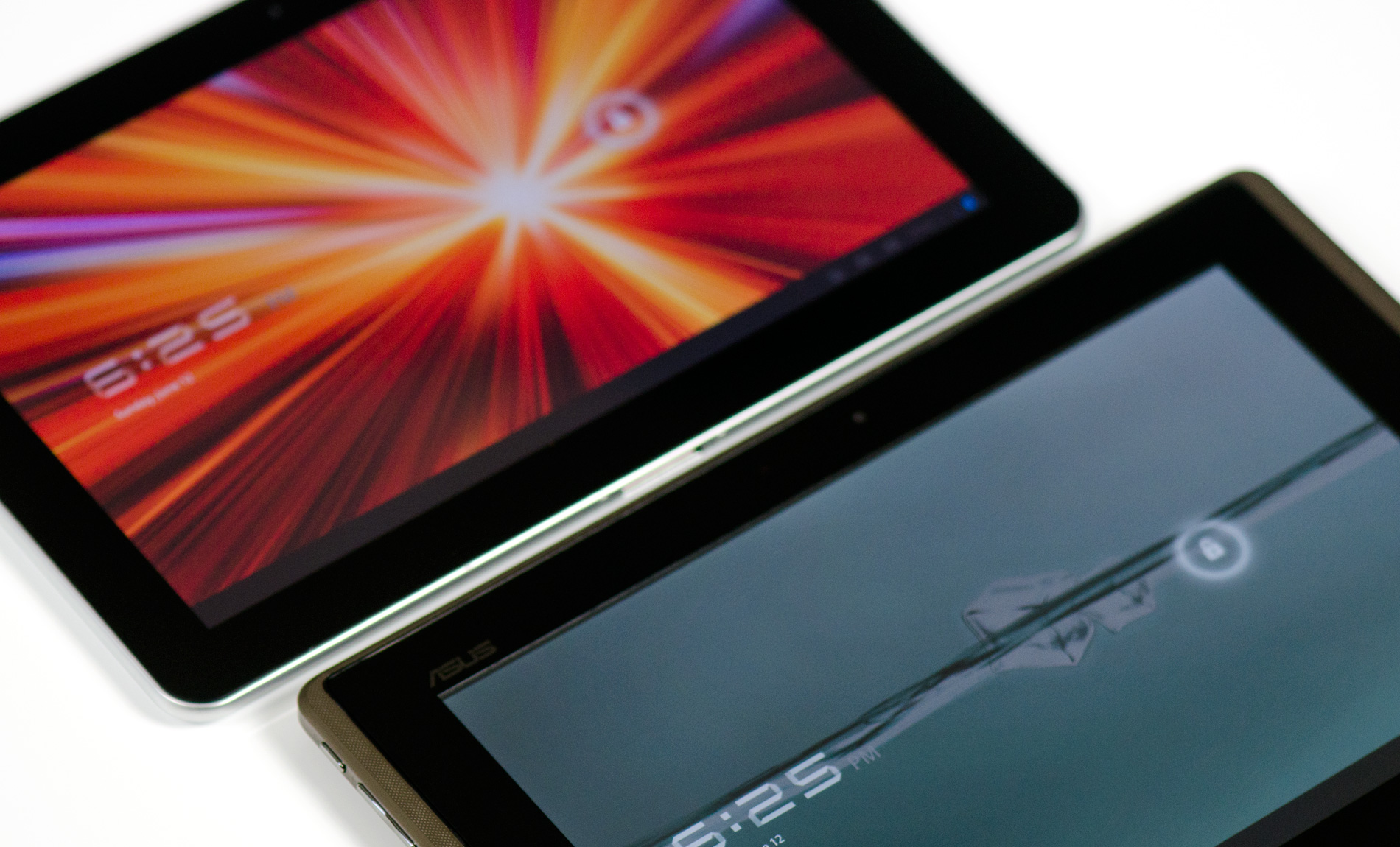
Samsung Galaxy Tab 10.1 (top) vs. ASUS Eee Pad Transformer (bottom)

Then ASUS showed up. At $399, the Eee Pad Transformer not only offered a different usage model to the iPad and Galaxy Tab, it brought a lower price tag as well. Availability has been slim thanks to component shortages, but with the Eee Pad selling for $399 the Galaxy Tab at $499 all of the sudden seems overpriced.

Based on specs alone you'd be right. Samsung's Galaxy Tab 10.1 has the same NVIDIA Tegra 2 tablet SoC inside, 1GB of LPDDR2 and 16GB of NAND on-board. You get a 10.1-inch 1280 x 800 PLS display and 802.11n WiFi support. 

Where Samsung gives you something more for your money is in build quality and form factor. While Eee Pad Transformer feels surprisingly good for a cost reduced tablet, it doesn't feel nearly as slim or portable as the Galaxy Tab 10.1. It's no wonder Samsung went back to the drawing board on this one, the result is something that in many ways feels better than the iPad 2.