
Even though Ridley Scott pronounced his Alien prequel dead, his new movie is leaking new details that A) creep us out and B) hint that Scott’s Prometheus will fit perfectly into the Alien mythology that Scott created years ago. More »
Reality Bites
Even though Ridley Scott pronounced his Alien prequel dead, his new movie is leaking new details that A) creep us out and B) hint that Scott’s Prometheus will fit perfectly into the Alien mythology that Scott created years ago. More »
Shared by Terren
Whoa!! Looks to me like the lightning is coming out of the Volcano and not actually striking it.

Japan’s Mount Kirishima is experiencing its biggest eruption in 50 years, sending smoke and ash 5,000 feet up into the air. And for the hell of it, a lightning bolt decided to strike the volcano at the same time. More »


New research suggests our brains delete information at an ‘extraordinarily high’ rate originally appeared on Engadget on Fri, 28 Jan 2011 09:45:00 EDT. Please see our terms for use of feeds.
Permalink  Geek.com | | Email this | Comments

Score one for Samsung in its eternal struggle against South Korean nemesis LG. Whereas the Life’s Good crew were licking their Q4 2010 wounds yesterday, Samsung’s had the pleasure of announcing that the final quarter of last year helped it bust through all its previous fiscal records: total revenue ($139b), net income ($14b), and operating profit ($15.5b) all reached all-time highs. The fourth quarter’s contribution was $2.7b in operating profit, 80.7 million mobile devices sold, 12.72 million flat panel TVs shipped, and two million Galaxy Tabs distributed to Android lovers yearning for some Froyo. That last number’s pretty important as it shows the Tab’s sales have almost doubled over the last month of the quarter — it reached one million sales in early December — indicating that there is indeed a hunger for slate-based computing. Oh, and if you’re wondering what Samsung’s planning for the future, there’s a reminder that a device with a Super AMOLED Plus screen and a dual-core processor is coming to replace the Galaxy S in the first half of 2011. Good to know.
[Thanks, Tascien]
Samsung Tabulates 2 million slates, 80 million phones sold in Q4 2010, breaks revenue records originally appeared on Engadget on Fri, 28 Jan 2011 06:59:00 EDT. Please see our terms for use of feeds.
Permalink Electronista |  Samsung Earnings Release Q4 2010 (PDF), Yonhap News | Email this | Comments

The BlackBerry Curve has always been our favorite ‘berry because of its solid keyboard and lack of pretension to any functionality beyond great messaging, but it looks like things are about to change fast: you’re looking at a leaked image of what CrackBerry says is the Curve Touch, codenamed “Malibu,” and it’s all touchscreen — unlike the rumored Apollo, there’s no keyboard in sight. We’ve only got specs on the CDMA version, and they’re right in line with what you’d expect for a midrange device due out in late 2011 / early 2012: 800MHz Qualcomm MSM8655 processor, 3.25-inch HVGA screen, 5 megapixel camera with HD video, 1GB storage with microSD expansion and 512MB of RAM, GPS, and NFC. Of course, CrackBerry says those are just “proposed specs,” so anything could change, but man — are we crazy for thinking an all-touch Curve definitely seems to redefine everything about what a BlackBerry is and is not?
BlackBerry Curve Touch leaks out originally appeared on Engadget on Thu, 27 Jan 2011 19:15:00 EDT. Please see our terms for use of feeds.

The Explorer process runs a lot of important things in Windows, and when it crashes, it can really slow you down. It turns out, however, that you can sandbox Explorer windows so if one crashes, it doesn’t drag your whole system down. More »

A 94-year-old Saskatchewan man who was in the eye of the media this week as the son of Canada’s oldest person has died.

Android: We’ve featured a few different methods and apps for finding your lost phone. With the $0.99 Seek Droid, however, you can locate your device, remotely lock it, wipe it, and even see your recent calls with almost no effort. More »
Users in the Google Earth forum often ask about the age of satellite imagery and when the content will be updated. While we aren’t able to tell you in advance when our imagery will be updated, we can now notify you after new images are added to an area that you’re interested in.
With our Follow Your World application, you can register points on the globe and we’ll send you an email update whenever the imagery is updated there.

In just three easy steps, you can add points such as your hometown, your college football stadium, or just about any place on Earth. And since Google Earth and Google Maps share the same imagery, this tool is equally handy for enthusiasts of both products. Follow Your World also provides a handy dashboard to manage your subscriptions.
Whether you’re an armchair geospatial enthusiast, or you frequently use aerial imagery from Google Earth or Google Maps in your work, we invite you to give this new app a try so you’ll be the first to know.
Posted by Jeral Poskey, Google Earth support team


Some astronomers think detecting an extraterrestrial radio signal is a matter of when, not if. What goes on in the immediate aftermath of such a discovery? Here’s what happened the last few times we thought we’d heard from E.T. More »

Microsoft just announced it’s had itself a solid second quarter, posting an $6.63 billion profit on record revenues of $19.95 billion. That’s more or less about the same as last year, when it racked up a $6.66 billion profit on $19 billion in revenue — and while the numbers look stable and Redmond managed to slightly beat estimates, things are changing fast underneath the bottom line: strong Kinect and Xbox 360 sales drove Entertainment and Devices Division revenue up 55 percent to $3.6 billion, but Windows and Windows Live revenue fell nearly 30 percent to $5.05 billion. That means the revenue gap between Microsoft’s consumer device business and the Windows business is now just some $1.3 billion, compared to $4.8 billion this time last year — and it undoubtedly explains why Xbox got top billing at Ballmer’s CES keynote this year, after traditionally being ignored, and why Microsoft is moving Windows to ARM as the mobile and tablet spaces heat up.
As for Windows Phone 7, there’s nary a peep, even though Microsoft was just crowing about moving 2 million licenses yesterday — we’re taking that to mean the infant OS hasn’t had any meaningful impact on revenue yet. We’re going to jump on the call at 5:30PM ET, we’ll let you know if anything good happens.
Update: Corrected the profit numbers: it’s a $6.63b profit and a $8.17b operating income, not a $8.17b profit.
Update 2: As noted by our friend Michael Gartenberg, Microsoft’s Q210 Windows division revenue was boosted by the inclusion of $1.71 billion in deferred Windows 7 upgrade sales and OEM pre-sales, so if you take those out, the gap between Windows and Xbox went from 3.1 billion in Q210 to 1.3 billion this quarter, and Windows sales are down 8 percent. It’s not a huge change for the big picture, but it’s worth noting the revenue deferral in context — Microsoft moved cash around so it would have a huge launch quarter for Windows 7, and now things are evening out.
Microsoft announces Q2 earnings: $6.63b profit, Xbox revenue up 55%, Windows down 29% originally appeared on Engadget on Thu, 27 Jan 2011 16:15:00 EDT. Please see our terms for use of feeds.
Permalink | Microsoft, Detailed Earnings | Email this | Comments
Shared by Terren
It’s been a long time since google has done any updates to Google Reader…would like to have seen more then just this.
 As some of you have noticed, we’ve recently enhanced Reader’s commenting abilities, via an “Options” menu that is present for all conversations about shared items. You can now get a link to the equivalent conversation in Google Buzz, which is handy for passing around a funny thread. If it’s your shared item, you can disable comments entirely, if for example the conversation was about a topic whose time has passed.
Additionally, you can now moderate comments within Reader. If the conversation is on an item that you shared, you have the option to remove comments directly. For all conversations, you can report comments as spam.
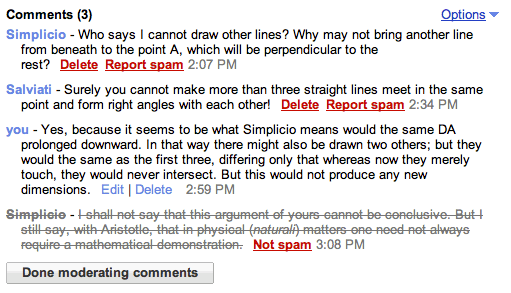
We hope these changes will help you keep an elevated level of discourse about shared items. As always, if you have any questions or comments about these new features, please head over to our help forums, or send us a message on Twitter.


 YouTube is confirming on their blog that Google has acquired the Fflick social movie service. The $10 million purchase, according to TechCrunch, will eventually give YouTube a new social discovery component to the service which will crawl popular social networks to glean popular videos shared amongst friends and the web in general. Previously, Fflick crawled Twitter’s public timeline to […]

Qwiki is a new webapp that helps you learn about virtually anything, but aims to inform you quickly by reading the articles to you while showing you a slideshow of pictures while you listen. More »

The internet! We’ve all spent enough time burrowing down the rabbit hole to know that it’s really, really big. But it’s not until you give its manifold parts some perspective that you understand how truly massive it is. More »

Created by Meekakitty, “Star Trek Girl” single is poised to be the biggest hit at 2011’s San Diego Comic Con. It’s hard not to get hooked on this cute little ditty, so grit your teeth and get in step. More »

Given the popularity of Apple’s iPad and the veritable glut of devices coming from companies like RIM, Motorola, Toshiba, et al, it’s only logical that a site as popular as Facebook would be working on a tablet-optimized version of its site.
The social network’s CTO Bret Taylor confirmed as much during a recent interview, stating, simply enough, “We need to make a tablet version of Facebook. It’s something we’re working on right now.” Fair enough, Bret.
Now, such an admission doesn’t mean that the company is necessary working on a native iPad app (though, again, we’d be surprised if such a thing didn’t surface in the next year), but Facebook may–much to Apple’s approval, no doubt–be working an HTML5 version of the site. “Long term we think a lot of apps will be written in HTML5,” said Taylor.
Facebook has apparently been “cautious” about fragmentation–or, at the very least, having its team spread thin with a proliferation of different device platforms. “The iPad was a casualty of that internally,” Taylor added.

Tried searching for “BitTorrent,” “RapidShare,” “uTorrent,” “MegaUpload” or even “Ubuntu torrent” lately? Good luck finding a Google domain that’ll autocomplete those results for you. Presumably caving to pleading from the MPAA and / or RIAA, El Goog has quietly begun to censor the results it shows when typing the above terms. Needless to say, the aforesaid companies aren’t too keen on the new procedures, and strangely enough, a number of other sites that would typically be grouped into this same category — MediaFire, 4shared and HotFile — remain on the cleared list. Hit the source link if you’re looking for loads of responses from companies angered with Google’s move, and feel free to reset your homepage to Bing, Yahoo or any other search engine who has yet to bend. You know, if you’re feeling rebellious.
Google begins censoring autocomplete results for BitTorrent, RapidShare and other Big Media profanity originally appeared on Engadget on Thu, 27 Jan 2011 10:24:00 EDT. Please see our terms for use of feeds.

Fixing people’s computers usually makes them appreciate you more, though this might be a little too far.

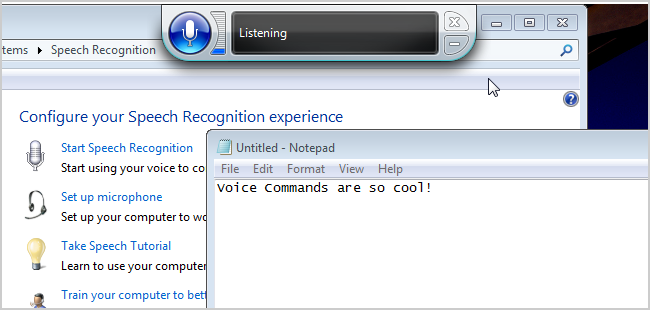
Ever get the desire to control your computer, Star Trek-style? With Windows 7’s Speech Recognition, it’s easier than you might think.
Microsoft has been working on its voice command steadily over the years. XP introduced it, Vista smoothed it, and 7 has it polished. It’s strangely not advertised as a feature, even though other voice command and speech recognition programs are hundreds of dollars. It may not be as perfect as some of them, but there’s definitely something amazing about vocally telling your computer to do things and it actually working


