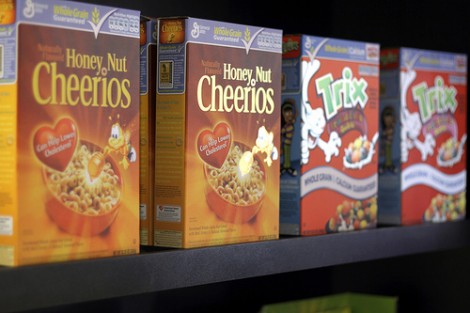
Wireless electricity enables next generation of annoying packaging

Yep, these cereal boxes light up. They’re using a new branded-technology called eCoupling that provides electricity via induction, which means the shelves have a coil with AC power running through it. The “printed coils” on the boxes allow inventory control and data exchange presumably thanks to a low-power microcontroller. But in the video after the break you can see that the printed lighting on the boxes lets them flash parts of the box art as a way to attract customers’ attention. We’d bet that they’re using electroluminescent materials but we weren’t able to get find specifics on how this is done. We just hope advertisers don’t start rolling noise-makers into their packaging.

[Crave via Laughing Squid]

Filed under: wireless hacks

Android 3.0 Honeycomb emulator has traces of smartphone support

Thought Honeycomb was just for tablets? Well, it’s not! Sure, tablets might be Google’s main thrust with the release, but we’ve been able to dig up enough evidence in the preview SDK’s emulator released yesterday to suggest that these guys are still keeping their eyes on the smartphone prize.

Here’s how it works: the emulator can be set to load at an arbitrary screen resolution. By default, that’s WXGA, 1280 x 768 — perfect for tablets, but obviously a wee bit large for even the biggest smartphones. Well, it turns out that setting the emulator to WVGA (like you might find on a modern mid- to high-end smartphone) triggers a moderately different shell UI that lacks most of the whiz-bang home screen stuff Google’s shown on the Honeycomb tablets. In fact, the default launcher crashes out entirely, which means you need to install a replacement (Launcher Pro works nicely) just to play around.

Once you get in, it’s pretty raw, but you immediately notice that the emulator’s got some traces of smartphone support. Notably, the status bar reverts to a more smartphone-friendly form, albeit one with pre-Gingerbread background coloration and incorrectly-inverted font colors. The lock screen (pictured above) is back to its old form, not the webOS-esque circular lock in the Honeycomb tablet UI. The browser — which has been completely revamped in Honeycomb — works, though without visible tabs; Google might be thinking that they’d take up too much real estate on a screen this small.

Again, you can’t glean much here, but it’s interesting primarily because the emulator knows to revert to a smartphone UI layout at the lower resolution — a possible sign that Honeycomb will be a true dual-mode, dual-purpose platform from day one. And even if it isn’t, it looks like they’re setting themselves up for a two-UI strategy down the road.

[Thanks, Andrew]

Android 3.0 Honeycomb emulator has traces of smartphone support originally appeared on Engadget on Fri, 28 Jan 2011 16:19:00 EDT. Please see our terms for use of feeds.

Permalink   |   | Email this | Comments
Internet Blows Lid Off of KFC Secret

colonel-sanders.jpg

Is nothing sacred, the Internet? Colonel Sanders’s long-protect military-style secret of 11 herbs and spices has apparently been revealed for all the world to see. Oregano, chili powder, basil–honestly, most of these things are readily found on in the average garden, save for one super-secret element (hint: it’s pretty much MSG).
This is the iPhone 4, Wikileaks cables, and Santa Claus's social security all rolled up in one. No clue as to the source of the alleged leak, but if this is true, it could shake up the Kentucky-style chicken deep-frying industry forever. 

Visualized: Google’s periodic table of APIs

The world of Google APIs and developer tools can be a confusing one, but the company has now at least brought a bit of order to the chaos with its own take on the periodic table of the elements. As you can see above, Android occupies the top spot normally reserved for hydrogen in the actual periodic table, and the remaining APIs and developer products are all grouped into their appropriate categories — and, of course, linked to their respective websites. Hit up the link below to check out the table in its interactive form.

Visualized: Google’s periodic table of APIs originally appeared on Engadget on Fri, 28 Jan 2011 14:21:00 EDT. Please see our terms for use of feeds.

Permalink   |  sourceGoogle  | Email this | Comments

Kinect Projects A New Hope In Holographic Tech

Microsoft’s Kinect has already brought us invisibility, motion-tracked underwear and giant animated Minecraft cats. Now, it’s taking us to a galaxy far far away, thanks to researchers from the MIT Media Lab. Using Kinect and a PC equipped with three off-the-shelf graphics cards, the researchers were able to create a three-inch holographic Princess Leia running at around 15 frames per second, according to the university’s news office

One of the students in the group dressed as Leia and re-enacted the famous scene from Star Wars in real-time at a conference in San Francisco last weekend. It might not have quite the resolution as R2’s projector in A New Hope, but its one of the fastest methods of projecting a hologram around today. According to an article on ScienceNews.org, a team at the University of Arizona was able to create a large hologram with much higher resolution using 16 cameras and a series of lasers. Unfortunately, this method was 30 times slower than MIT's Kinect hack, refreshing the image once every two seconds. 

Maybe the most impressive thing about this hack was that the MIT researchers only got their hands on a Kinect around the end of December, giving them about a month to not only create the hologram, but double the frame rate from 7.5 frames per second to 15. 
Before you run out and wire up your own droids with appeals to Ben Kenobi, keep in mind that there is still one component of the setup that can't be bought in stores. The holographic display used in the project has been developed by MIT since the late-1980s by two groups of professors and their students. The current display, called the Mark-II, is the successor to the original. Professor Michael Bove said his group is developing a larger and cheaper display using the same technology. 

Here’s a video of the hologram, projected in real-time over the Internet:

New research suggests our brains delete information at an ‘extraordinarily high’ rate

The mysteries of the brain may be virtually endless, but a team of researchers from two institutes in Göttingen, Germany now claim to have an answer for at least one question that has remained a puzzle: just how fast does the brain forget information? According to the new model of brain activity that the researchers have devised, the answer to that is one bit per active neuron per second. As Fred Wolf of the Max Planck Institute for Dynamics and Self-Organization further explains, that "extraordinarily high deletion rate came as a huge surprise," and it effectively means that information is lost in the brain as quickly as it can be delivered — something the researchers say has "fundamental consequences for our understanding of the neural code of the cerebral cortex."

Continue reading New research suggests our brains delete information at an ‘extraordinarily high’ rate

New research suggests our brains delete information at an ‘extraordinarily high’ rate originally appeared on Engadget on Fri, 28 Jan 2011 09:45:00 EDT. Please see our terms for use of feeds.

Permalink Geek.com  |   | Email this | Comments

Samsung Tabulates 2 million slates, 80 million phones sold in Q4 2010, breaks revenue records

Score one for Samsung in its eternal struggle against South Korean nemesis LG. Whereas the Life’s Good crew were licking their Q4 2010 wounds yesterday, Samsung’s had the pleasure of announcing that the final quarter of last year helped it bust through all its previous fiscal records: total revenue ($139b), net income ($14b), and operating profit ($15.5b) all reached all-time highs. The fourth quarter’s contribution was $2.7b in operating profit, 80.7 million mobile devices sold, 12.72 million flat panel TVs shipped, and two million Galaxy Tabs distributed to Android lovers yearning for some Froyo. That last number’s pretty important as it shows the Tab’s sales have almost doubled over the last month of the quarter — it reached one million sales in early December — indicating that there is indeed a hunger for slate-based computing. Oh, and if you’re wondering what Samsung’s planning for the future, there’s a reminder that a device with a Super AMOLED Plus screen and a dual-core processor is coming to replace the Galaxy S in the first half of 2011. Good to know.

[Thanks, Tascien]

Continue reading Samsung Tabulates 2 million slates, 80 million phones sold in Q4 2010, breaks revenue records

Samsung Tabulates 2 million slates, 80 million phones sold in Q4 2010, breaks revenue records originally appeared on Engadget on Fri, 28 Jan 2011 06:59:00 EDT. Please see our terms for use of feeds.

Permalink Electronista  |  sourceSamsung Earnings Release Q4 2010 (PDF), Yonhap News  | Email this | Comments

BlackBerry Curve Touch leaks out

The BlackBerry Curve has always been our favorite ‘berry because of its solid keyboard and lack of pretension to any functionality beyond great messaging, but it looks like things are about to change fast: you’re looking at a leaked image of what CrackBerry says is the Curve Touch, codenamed “Malibu,” and it’s all touchscreen — unlike the rumored Apollo, there’s no keyboard in sight. We’ve only got specs on the CDMA version, and they’re right in line with what you’d expect for a midrange device due out in late 2011 / early 2012: 800MHz Qualcomm MSM8655 processor, 3.25-inch HVGA screen, 5 megapixel camera with HD video, 1GB storage with microSD expansion and 512MB of RAM, GPS, and NFC. Of course, CrackBerry says those are just “proposed specs,” so anything could change, but man — are we crazy for thinking an all-touch Curve definitely seems to redefine everything about what a BlackBerry is and is not?

BlackBerry Curve Touch leaks out originally appeared on Engadget on Thu, 27 Jan 2011 19:15:00 EDT. Please see our terms for use of feeds.

Permalink   |  sourceCrackberry  | Email this | Comments

Sign up for imagery update alert

Users in the Google Earth forum often ask about the age of satellite imagery and when the content will be updated. While we aren’t able to tell you in advance when our imagery will be updated, we can now notify you after new images are added to an area that you’re interested in.

With our Follow Your World application, you can register points on the globe and we’ll send you an email update whenever the imagery is updated there.

In just three easy steps, you can add points such as your hometown, your college football stadium, or just about any place on Earth. And since Google Earth and Google Maps share the same imagery, this tool is equally handy for enthusiasts of both products. Follow Your World also provides a handy dashboard to manage your subscriptions.

Whether you’re an armchair geospatial enthusiast, or you frequently use aerial imagery from Google Earth or Google Maps in your work, we invite you to give this new app a try so you’ll be the first to know.

Posted by Jeral Poskey, Google Earth support team

Microsoft announces Q2 earnings: $6.63b profit, Xbox revenue up 55%, Windows down 29%

Microsoft just announced it’s had itself a solid second quarter, posting an $6.63 billion profit on record revenues of $19.95 billion. That’s more or less about the same as last year, when it racked up a $6.66 billion profit on $19 billion in revenue — and while the numbers look stable and Redmond managed to slightly beat estimates, things are changing fast underneath the bottom line: strong Kinect and Xbox 360 sales drove Entertainment and Devices Division revenue up 55 percent to $3.6 billion, but Windows and Windows Live revenue fell nearly 30 percent to $5.05 billion. That means the revenue gap between Microsoft’s consumer device business and the Windows business is now just some $1.3 billion, compared to $4.8 billion this time last year — and it undoubtedly explains why Xbox got top billing at Ballmer’s CES keynote this year, after traditionally being ignored, and why Microsoft is moving Windows to ARM as the mobile and tablet spaces heat up.

As for Windows Phone 7, there’s nary a peep, even though Microsoft was just crowing about moving 2 million licenses yesterday — we’re taking that to mean the infant OS hasn’t had any meaningful impact on revenue yet. We’re going to jump on the call at 5:30PM ET, we’ll let you know if anything good happens.

Update: Corrected the profit numbers: it’s a $6.63b profit and a $8.17b operating income, not a $8.17b profit.

Update 2: As noted by our friend Michael Gartenberg, Microsoft’s Q210 Windows division revenue was boosted by the inclusion of $1.71 billion in deferred Windows 7 upgrade sales and OEM pre-sales, so if you take those out, the gap between Windows and Xbox went from 3.1 billion in Q210 to 1.3 billion this quarter, and Windows sales are down 8 percent. It’s not a huge change for the big picture, but it’s worth noting the revenue deferral in context — Microsoft moved cash around so it would have a huge launch quarter for Windows 7, and now things are evening out.

Microsoft announces Q2 earnings: $6.63b profit, Xbox revenue up 55%, Windows down 29% originally appeared on Engadget on Thu, 27 Jan 2011 16:15:00 EDT. Please see our terms for use of feeds.

Permalink   |  sourceMicrosoft, Detailed Earnings  | Email this | Comments

More control over comments on shared items

Shared by Terren

It’s been a long time since google has done any updates to Google Reader…would like to have seen more then just this.

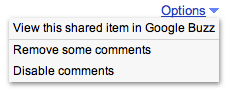
Options menuAs some of you have noticed, we’ve recently enhanced Reader’s commenting abilities, via an “Options” menu that is present for all conversations about shared items. You can now get a link to the equivalent conversation in Google Buzz, which is handy for passing around a funny thread. If it’s your shared item, you can disable comments entirely, if for example the conversation was about a topic whose time has passed.

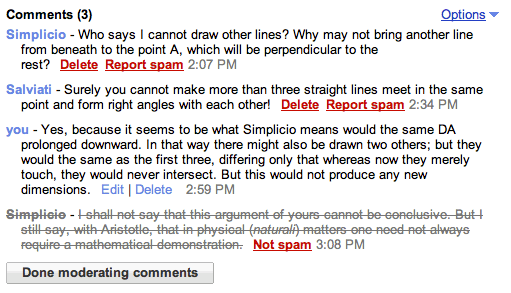
Additionally, you can now moderate comments within Reader. If the conversation is on an item that you shared, you have the option to remove comments directly. For all conversations, you can report comments as spam.

Comment moderation

We hope these changes will help you keep an elevated level of discourse about shared items. As always, if you have any questions or comments about these new features, please head over to our help forums, or send us a message on Twitter.