Google’s Android 3.0 Honeycomb for tablets: a guided tour of the UI (video)

A funny thing happened after Google posted (and subsequently pulled) its Android 3.0 Honeycomb video: T-Mobile celebrated its G-Slate announcement by posting the same video. And about six more after that (to be fair, they’re also on the Motorola / Verizon Xoom we demoed). Today it was made official during Verizon’s keynote, with Google itself narrating a hands-on demo. We’ve scrutinized these videos to no end and we think we’ve come up with the most complete picture of Google’s tablet OS experience at this point. Join us after the break for all the goods.

Continue reading Google’s Android 3.0 Honeycomb for tablets: a guided tour of the UI (video)

Google’s Android 3.0 Honeycomb for tablets: a guided tour of the UI (video) originally appeared on Engadget on Thu, 06 Jan 2011 13:44:00 EDT. Please see our terms for use of feeds.

Permalink   |   | Email this | Comments

Honeycomb will not require dual-core CPU as minimum hardware spec

Oh, never mind then. Google’s ever-informative and ever-knowledgeable Dan Morrill has disabused the world from the bogus belief that Android’s “made for tablets” iteration, aka Honeycomb, will require a dual-core processor as a minimum to run. Dan says there are no specific CPU requirements for aspiring Android 3.0 tablets to meet and we should all sit back, relax, and enjoy our breakfast. That’s reassuring to note, but let’s not read more into it than what’s said — while Honeycomb might not technically require a dual-core beastie to power it, there’s a reason why the Motorola Xoom (which is soon to become the first device to offer Honeycomb onboard) is launching with a Tegra 2 chip inside.

[Thanks, Dean]

Honeycomb will not require dual-core CPU as minimum hardware spec originally appeared on Engadget on Thu, 06 Jan 2011 10:21:00 EDT. Please see our terms for use of feeds.

Permalink   |  source@morrildl (Twitter)  | Email this | Comments

Microsoft and Samsung unveil SUR40, the ‘Surface 2.0 Experience’ you still can’t buy (video)

Microsoft and Samsung unveil SUR40, the

It’s been years since Microsoft first wowed us with Surface, years that we’ve been looking at cool applications for the smart tables, but still Microsoft thinks you aren’t ready. Or aren’t rich enough, anyway. Samsung has unveiled the “SUR40 with Microsoft Surface,” a third-party implementation and what’s being called the “2.0 Experience.” On the outside things look a bit different, with a variety of pedestals that the thing can be mounted to, including one with two wood panels that flow up to cradle the display. But, if you like, the 40-inch, 1080p screen and the 2.9GHz AMD Athlon II X2 processor and Radeon HD 6700M behind it is now wall-mountable, meaning it really isn’t technically a smart table at all. Up top the interface looks more polished and refined, and naturally Windows Phone 7 support has been added, as you can see in the video below. It all looks rather good, we think, but it’s all rather focused on businesses as ever.

Continue reading Microsoft and Samsung unveil SUR40, the ‘Surface 2.0 Experience’ you still can’t buy (video)

Microsoft and Samsung unveil SUR40, the ‘Surface 2.0 Experience’ you still can’t buy (video) originally appeared on Engadget on Thu, 06 Jan 2011 09:47:00 EDT. Please see our terms for use of feeds.

Permalink   |  sourceMicrosoft Surface  | Email this | Comments

Samsung 9 Series and Sliding PC 7 Series quick hands-on (video)

It’s been a crazy day, but we hope you didn’t miss Samsung’s Sliding PC 7 Series. The little laptop / tablet hybrid does just what the name suggests, with the display literally sliding over the keyboard. Of course, we had to get video of it in action, which you can enjoy after the break. Some pictures are below, too, both of the 7 Series and ultra-thin 9 Series. Needless to say, we’re going back for seconds.

Continue reading Samsung 9 Series and Sliding PC 7 Series quick hands-on (video)

Samsung 9 Series and Sliding PC 7 Series quick hands-on (video) originally appeared on Engadget on Thu, 06 Jan 2011 01:39:00 EDT. Please see our terms for use of feeds.

Permalink   |   | Email this | Comments

Canadian fans deflated by world juniors loss

Canadian fans are expressing frustration over Team Canada’s stunning 5-3 loss to the Russians in the gold-medal match of the world junior hockey championship, with many feeling the teen Canucks let up after taking a three-goal lead.

Motorola Xoom first hands-on! (update: video!)

Look what we found hanging around the Motorola stand at CES this evening: none other than the just announced Motorola Xoom tablet. While this sleek little device is still running a very early build of Honeycomb, we were able to sneak some peeks at the stuff Google and Motorola don’t actually want you to see just yet. The device was looping demo videos of the Honeycomb UI, but a little investigation on our part revealed a bare bones homescreen. We’re still trying to decipher just what we saw, but for now check out the first hands-on images in the gallery below.

Update: We went back to do a little more investigation, and this thing is most definitely running Honeycomb. We were able to bring up the app pane, and saw the full suite of Google apps within. We also caught a new app switcher, which is invoked by hitting a little icon that resembles a deck of cards. Check out the UI shots in the second gallery.

Update 2: Now with video after the break!

Continue reading Motorola Xoom first hands-on! (update: video!)

Motorola Xoom first hands-on! (update: video!) originally appeared on Engadget on Thu, 06 Jan 2011 00:19:00 EDT. Please see our terms for use of feeds.

Permalink   |   | Email this | Comments

Microsoft Touch Mouse unveiled, available for $80 in June

No, that’s not Microsoft’s Arc Touch mouse, it’s just the Touch Mouse. Confusing, we know, but this one is more than just a mouse with a touch strip — the entire top of it consists of a “matrix of capacitive touch-sensing electrodes,” and naturally, it supports different multittouch gestures. Based on Microsoft Research concepts, the device will support a slew of gestures, including flicks, pinch-to-zoom, and panning. That all is best seen in the video below, but the sleek black mouse also packs Microsoft’s BlueTrack technology, so it should work on carpets, wood, etc. Like most other 2.4GHz mice out there it has a small USB receiver — sorry, no Bluetooth here. Undoubtedly, it looks pretty sexy, but according to the press release after the break it won’t be available until June for $79.95.

Updated: Microsoft has launched its Touch Mouse landing page and the mouse is up for pre-order now at Amazon. We’d wait for our hands-on impressions before pulling out the plastic, but that’s just us.

Update 2: We’re back again. The Windows Team Blog has some more information on the gestures. We also stole a few of their pictures and put them in the gallery below.

Continue reading Microsoft Touch Mouse unveiled, available for $80 in June

Microsoft Touch Mouse unveiled, available for $80 in June originally appeared on Engadget on Wed, 05 Jan 2011 22:36:00 EDT. Please see our terms for use of feeds.

Permalink   |  sourceMicrosoft, Amazon, Microsoft (2)  | Email this | Comments

Android text messaging bugs acknowledged, fixes detailed

Hear that thunderous roar off in the distance, growing louder (and more frightening) as it persists? That is the sound of excited Android users emailing us to inform their fave gadget site that Google has just sent users an update to that little embarrassing SMS bug that we reported a while back. There seem to be two distinct issues: users have reported both opening one message to have a completely different message appear, and / or sending an text message to one contact yet having it delivered to another contact entirely. We need only say one word: sexting, to highlight just how dangerous this could be! Google promises us that a fix for these two issues are in the works. In the meanwhile, check out the e-mail below to read their response and work-around.

[Thanks Jon, and thanks to everyone else who sent this in!]

Continue reading Android text messaging bugs acknowledged, fixes detailed

Android text messaging bugs acknowledged, fixes detailed originally appeared on Engadget on Wed, 05 Jan 2011 22:21:00 EDT. Please see our terms for use of feeds.

Permalink   |  sourceGoogle  | Email this | Comments

8 million Kinect sensors sold in first 60 days

8 million Kinect sensors sold worldwide in first 60 days — that’s 3 million more than Microsoft had planned. Not bad. Microsoft also announced 30 million Xbox Live members and 50 million units sold worldwide with the Xbox 360 outselling all other consoles for the last 6 months in the US. Not bad at all.

8 million Kinect sensors sold in first 60 days originally appeared on Engadget on Wed, 05 Jan 2011 22:06:00 EDT. Please see our terms for use of feeds.

Permalink   |   | Email this | Comments

Avatar Kinect for Xbox 360 is official, smile like you mean it

Turns out the rumor was true, Avatar Kinect is coming to the Xbox 360 this spring (for Xbox Live Gold members, at least). Details are sparse — a place where you can virtually hang out with your “friends” — but Kinect is shown to now be able to detect facial gestures like eyebrows, smiles, and laughs. Impressive, but after all we’ve seen with the Kinect hacks, can’t say we’re too surprised the camera’s capable of such detection.

Avatar Kinect for Xbox 360 is official, smile like you mean it originally appeared on Engadget on Wed, 05 Jan 2011 22:02:00 EDT. Please see our terms for use of feeds.

Permalink   |   | Email this | Comments

Netflix and Hulu Plus with Kinect coming this spring to Xbox 360

Good news, Hulu Plus is finally coming to Xbox 360 this spring. Better news, both Hulu Plus and Netflix will be compatible with Kinect. We imagine it’ll be just like Zune Video’s interface, but there really wasn’t much of a demo during Ballmer’s keynote tonight. Excited? We are.

Netflix and Hulu Plus with Kinect coming this spring to Xbox 360 originally appeared on Engadget on Wed, 05 Jan 2011 21:57:00 EDT. Please see our terms for use of feeds.

Permalink   |   | Email this | Comments

A Sneak Peek of Android 3.0, Honeycomb

The past few weeks have been exciting ones for the Android team: we recently released Nexus S and Android 2.3, Gingerbread, and we’ve even had some of our most popular team members take a trip to space. But we haven’t stopped buzzing with excitement: today at the Consumer Electronic Show (CES) in Las Vegas, we previewed Android 3.0, Honeycomb.

Honeycomb is the next version of the Android platform, designed from the ground up for devices with larger screen sizes, particularly tablets. We’ve spent a lot of time refining the user experience in Honeycomb, and we’ve developed a brand new, truly virtual and holographic user interface. Many of Android’s existing features will really shine on Honeycomb: refined multi-tasking, elegant notifications, access to over 100,000 apps on Android Market, home screen customization with a new 3D experience and redesigned widgets that are richer and more interactive. We’ve also made some powerful upgrades to the web browser, including tabbed browsing, form auto-fill, syncing with your Google Chrome bookmarks, and incognito mode for private browsing.

Honeycomb also features the latest Google Mobile innovations including Google Maps 5 with 3D interactions and offline reliability, access to over 3 million Google eBooks, and Google Talk, which now allows you to video and voice chat with any other Google Talk enabled device (PC, tablet, etc).

Please stay tuned for more Honeycomb news from the Android team. For now, you can get a taste of Honeycomb by checking out this video.

Posted by Andy Rubin, VP of Engineering

“Windows 8” will run on ARM natively, Microsoft says

By Ed Oswald, Betanews
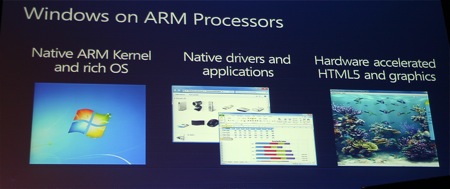
Windows for ARM
Microsoft is taking notice of industry trends, and told attendees Wednesday at the Consumer Electronics Show in Las Vegas that the next version of Windows would run on ARM chips. The move is an acknowledgement of the changing face of consumer electronics — that smart phones, tablets, and portable devices are indeed the future.

The move is also significant for another reason — up until now, Microsoft on ARM was relegated to the stripped down versions of Windows, either Windows Mobile, CE, or Embedded. Having the capability to run a full version of the operating system natively on these mobile processors opens up more possibilities for manufacturers in developing compact devices, the Redmond company believes.
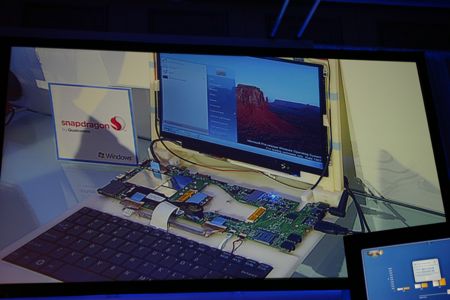
Windows running on Qualcomm's Snapdragon platform

“We’ve reached a point in technology where everyone really does want everything from their computing experience,” Windows chief Steven Sinfosky said in explaining the decision. “Today’s demonstrations will highlight the work we have done on the architecture of Windows to enable the richness of the Windows platform to run natively on the ARM platform.”

Some manufacturers have already attempted to put Windows 7 on tablet devices, but the fact that the OS itself is still built for an x86 architecture does not make it optimal as it requires more battery life and power than can be fit into the smaller form factors of these devices effectively.

Other considerations are a native touch screen interface — something Windows 7 essentially lacks — and a user interface that works well with that type of input. It was not immediately clear if Microsoft also plans to make these necessary user interface tweaks as part of this new commitment.

Sinofsky was somewhat vague on bringing other critical applications — such as Office — to the ARM platform, only offering that Microsoft was “committed to making sure that Windows on [system-on-a-chip] architectures is a rich Windows experience.”
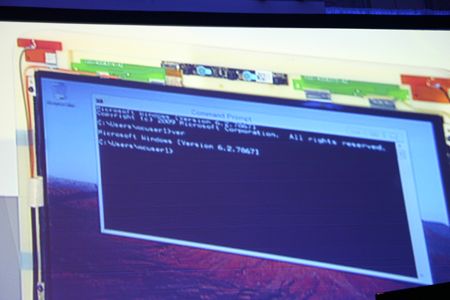
Build number of Windows on NVidia Tegra 2 machine

The build number of Windows running on the NVidia Tegra-based machine

The Redmond company did not offer any guidance as to when Windows 8 (as it is thought to be called) may release, although it is likely not for another two years. That said, the question now becomes whether that time frame may be too late.

With the ever quicker pace of innovation in mobile computing, in two years ARM may be yesterday’s news, leaving Microsoft scrambling once again to keep pace.

Copyright Betanews, Inc. 2010


Add to Twitter
Add to digg
Add to Google
Add to Slashdot
Add to Facebook
Add to Technorati
Email this Article