Electricity rates are going up 4.5 per cent in Saskatchewan, starting Aug. 1.
New software beta lets Windows PCs use iPad as wireless monitor
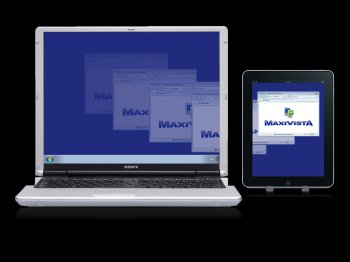
Windows users can now use the Apple iPad as a wireless display extension with a software package released in beta today called MaxiVista from German software company Bartels Media.
MaxiVista’s multi-monitor software lets users extend their desktop across other PCs and Notebooks, and utilizes a special data compression so the CPU and network load stay low. While the frame rate isn’t exactly good enough to handle video playback or gaming, it is useful for non-graphically intensive applications, and it doesn’t require any unique hardware.
“The new graphic card standard, WDDM, that was introduced with Windows Vista prohibited the use of multiple graphic cards from different manufacturers on one computer. MaxiVista is the first application of its kind to overcome these limitations and functions with Windows XP as well as with Windows Vista and Windows 7,” General Manager Gunnar Bartels told us this morning.
For MaxiVista to function, users must download a $9.99 iPad application. The Windows part of the software is free, and video drivers are compatible with both 32 and 64 Bit operating systems. Interestingly, there is not a version yet compatible with OS X, but it is reportedly on the way.


Presented By:
| We are pleased to announce dlvr.it now supports Google Buzz! You can now easily distribute your content to Google Buzz, and track your Buzz followers and stats with dlvr.it.
To start posting to Google Buzz with dlvr.it: 1. Sign… |
||
| dlvr.it >> Read more |
Windows Vista – Windows XP – Window 7 – Operating system – Microsoft Windows
Ford Sync voice recognition explodes to more than 10,000 commands
Today, Ford announced that its Sync in-car command, navigation, and entertainment system has improved its voice recognition interface by increasing the vocabulary by more than 100x, allowing system commands to be much simpler and more direct.
The Sync system was developed through Ford’s partnership with Microsoft, and launched in 2007 on twelve 2008 Ford vehicles. At first, the system was very limited in what it could do, and included the ability to operate USB media players hands-free, connect to mobile phones via bluetooth, and export diagnostic data. The voice interface launched with around 100 commands, which reflected more or less the menu structure of the system.
With the new voice command system available in the next generation of Sync called MyFord Touch, users will be able to speak commands in various ways and not have to simply navigate menus by voice.
For example, users would have to first say what device they were going to access before they could perform an action. If they wanted to call someone, they first had to say “Phone,” or if they wanted to switch the song that was playing on their iPod or Zune, they’d have to first say “USB.” With the new system, users can just say “Call (name),” for example, and the connected phone will start the calling process.
“As we’ve gained processing power and learned more about how drivers use the system, we’ve been able to refine the interface. Customers can do more and say more from the top-level menu, helping them accomplish their tasks more quickly and efficiently,” said Brigitte Richardson, Ford global voice control technology and speech systems lead engineer.
The speech recognition engine, designed by Nuance Communications, can recognize different voices and create user profiles for them within three commands. This means multiple users can easily use the hands-free system without having to “train” it, as other systems currently require.
The new voice recognition system, and MyFord Touch, is launching this year on the 2011 Ford Edge.
Presented By:
| Social Media. You know you need to be there. But how do you measure social media ROI? How do you know if it is working?
dlvr.it now makes it easy to integrate Google Analytics and Omniture tracking into your… |
||
| dlvr.it >> Read more |
Ford Sync – Speech recognition – Microsoft – Nuance Communications – Speech Technology
Bloomberg: Apple engineer was concerned about iPhone 4 antenna early on

As if we needed any more drama in this situation, Bloomberg has someone “familiar with the matter” that claims Apple’s own antenna expert, Ruben Caballero, told Apple management that the iPhone 4 antenna design could cause reception problems, dropped calls, and a serious engineering challenge. Caballero is a senior engineer for Apple with a large quantity of antenna patents under his belt, and while we certainly don’t know the whole story — perhaps his claims were somehow quelled by Apple’s own testing — it certainly adds a twist to this story if Steve Jobs and co. had been alerted to this very real problem during the design phase. The Bloomberg article also claims, from a different source, no less, that a carrier partner also raised antenna concerns before the release. Apple and Caballero naturally did not comment on this report. We’re not really sure about the real-world implications of all this behind-the-scenes drama, but we suppose we’ll see what Apple has to say for itself tomorrow.
Bloomberg: Apple engineer was concerned about iPhone 4 antenna early on originally appeared on Engadget on Thu, 15 Jul 2010 10:32:00 EDT. Please see our terms for use of feeds.
Permalink |  Bloomberg | Email this | Comments
Try Out Three Early Web Apps from the Chrome Web Store Now [Webapps]

HP Android tablet coming later than you think, or not at all

Although nothing official has come from HP on this front, we got some pretty solid word back in April that the American giant was mulling an Android tablet. As it turns out, what with the WebOS acquisition that followed and HP’s dogged commitment to Windows 7, that Googly project has apparently slipped out of the limelight in HP HQ. Word from All Things Digital is that there’ll be nothing forthcoming this year (as was tentatively expected) and if an HP Android tablet is to materialize, it’ll have to come in 2011. The company seems to be in the midst of reallocating resources to its higher priority projects, and who knows, should that rumored Hurricane tablet blow us all away, Android might never gets its chance to shine at all.
HP Android tablet coming later than you think, or not at all originally appeared on Engadget on Thu, 15 Jul 2010 06:51:00 EDT. Please see our terms for use of feeds.
Apple deleting mentions of Consumer Reports’ iPhone 4 piece on forums, can’t delete your thoughts

…or can they? In case Apple has somehow managed to perfect the art of selective disremembrance across a wide population, here’s a refresher: Consumer Reports has thrown down the gauntlet, stating that it “can’t recommend” the iPhone 4 until the antenna issues are fixed, issues that its labs and ours have verified quite substantially. Apple apparently isn’t happy about that, and has taken to deleting threads about the Consumer Reports article from its support forums. Now, Apple deleting threads from its support forums is nothing new; outside of “regular” moderation, the company routinely deletes discussion of hardware flaws that it’s not ready to ‘fess up to, or just generally negative lines of thought about its products. Good thing the internet’s a big place, and if Apple’s not going to admit the antenna issue, there are plenty of ways to gripe about it. Feel free to express yourself in the comments below, for instance!
Apple deleting mentions of Consumer Reports’ iPhone 4 piece on forums, can’t delete your thoughts originally appeared on Engadget on Mon, 12 Jul 2010 20:34:00 EDT. Please see our terms for use of feeds.
Permalink | TUAW | Email this | Comments
Pickup swept into river; 2 missing
Two men from Yorkton, Sask., are missing and a third was arrested after a pickup truck was swept off a bridge by flood water in east-central Saskatchewan.
Microsoft’s Windows Phone Developer Tools package goes to beta

Early versions of the tools Windows Phone 7 developers will use to craft their wares have been floating around since Microsoft’s MIX event in March, but it looks like things have finally gotten robust and feature-complete enough this week to bless the kit with a beta label. In fact, Microsoft is coming out and saying that this release “represents the near final version,” which we take to mean you can develop with some confidence that your world won’t be turned upside down when the time comes to prep your apps for shipping devices and firmwares. The actual API has been tweaked and Expression Blend is now fully integrated with the tools, though there are apparently still a few controls that aren’t ready for primetime and will be added over the coming weeks. Oh, and if no emulator is enough to satisfy your intense cravings, you might be excited to learn that more developer devices are slated to ship next week — so keep an eye on your mailbox and your porch if you signed up to get one.
Microsoft’s Windows Phone Developer Tools package goes to beta originally appeared on Engadget on Mon, 12 Jul 2010 15:57:00 EDT. Please see our terms for use of feeds.
Permalink | Windows Phone Developer Blog | Email this | Comments
BlackBerry Protect Lets You Wirelessly Backup, Restore And Locate Your Lost Blackberry For Free [BlackBerry]

RIM’s introducing BlackBerry Protect, a new feature that lets users wirelessly backup, restore, and locate their lost BlackBerrys for free. Basically your already very secure BlackBerry will be even safer. And you didn’t have to pay a penny. More »

BlackBerry – Handhelds – Research In Motion – Smartphone – RIM
Extensive Consumer Reports Testing Gets to the Bottom of iPhone 4 Reception Problem [Gadgets]

Product review publication Consumer Reports took an extensive look at the iPhone 4’s reception to get to the bottom of the reception problem. Their findings seem to contradict Apple’s claim that it’s a software issue, pointing out that no other tested phones experience the signal loss that the iPhone 4 does. CR recommends a simple-but-ugly fix involving duct tape, and if the solution really is "get a case", it's not the end of the world—we'd just expect Apple to offer a free case rather than require you to buy one. [Consumer Reports] More »

IPhone – Apple – ConsumerReports – iPhone 4 – Smartphone
IPhone antitrust case advanced
A U.S. federal judge says a monopoly abuse lawsuit against Apple Inc. and AT&T Inc.'s mobile phone unit can move forward as a class action.
Windows 7 SP1 public beta released
Microsoft announced on Monday that the first Windows 7 Service Pack 1 public beta is now available.
Speaking at Microsoft's Worldwide Partner Conference in Washington, Corporate Vice President of Windows & Windows Live – Tami Reller announced the public beta. Microsoft revealed its plans for Windows 7 SP1 and Windows Server…
App Inventor for Android
App Inventor is a new tool in Google Labs that makes it easy for anyone—programmers and non-programmers, professionals and students—to create mobile applications for Android-powered devices. And today, we’re extending invitations to the general public.
For many people, their mobile phone—and access to the Internet—is always within reach. App Inventor for Android gives everyone, regardless of programming experience, the opportunity to control and reshape their communication experience. We’ve observed people take pride in becoming creators of mobile technology and not just consumers of it.
For the past year, we’ve been testing App Inventor in classrooms around the United States, and we’ve found that it opens up the world of computer programming to students in new and powerful ways. David Wolber, professor of computer science at the University of San Francisco and part of the initial pilot program, says “students traditionally intimidated by technology are motivated and excited to program with App Inventor.” One student from Professor Wolber’s class told us: “I used to think that no one could program except CS people. Now, I’ve made dozens of applications for the Android phone!” Another student, who struggles with dyslexia, was inspired by App Inventor to take more computer science classes and is now learning Python. Check out this video to hear more about App Inventor for Android at University of San Francisco.
Visit our site to learn more about App Inventor and see sample apps. To request an invitation, fill out this form and you’ll soon be on your way to building mobile applications. And check out the video below to see how it works. We can’t wait to see what you create!
Posted by Mark Friedman, Google Engineer


Windows 7-based HP Slate referenced at WPC 2010, Ballmer says ‘hardcore’ tablet push coming

Is this the answer to the question we posed back in mid-June? Maybe. While we’re still unsure if Hewlett-Packard has a webOS-based tablet in its pipeline, those on-again / off-again Windows 7 rumors may finally be nearing an end. On the homepage of this year’s Microsoft Worldwide Partner Conference — which kicks off in earnest today in Washington, D.C. — there’s a pane of Windows 7 slates that are on deck for this year. Er, a pane with vendors promising Win7 slates this year. Sure enough, HP’s logo is front and center, right alongside the likes of Sony, Dell, ASUS, Panasonic, Onkyo, Toshiba, MSI, Samsung, Lenovo and Fujitsu. We’ll be keeping an ear to the ground for more, but for now, feel free to let your imaginations run wild. It’s Monday, after all.
Update: During the event’s opening keynote, which was headed by none other than Microsoft CEO Steve Ballmer, the bigwig confirmed some of what’s pictured above: Windows 7 slates will be arriving this year. Interestingly, he never mentioned HP by name (despite teasing us gently at CES with an apparent mystery device), but he did note that devices would be available at various price points and in a variety of form factors — “with keyboards, touch only, dockable, able to handle digital ink, etc.” We already knew as much from being overwhelmed by prototypes at Computex, but it’s good to get the word straight from Ballmer himself. Now, to see if anyone’s actually interested in buying a desktop OS on a mobile form factor…
Update 2: Seems Ballmer’s drinking his own Kool-Aid in a serious way, and not just on the tablet front. He noted that Microsoft will be giving consumers “a set of Windows-based devices that people will be proud to carry at home and will fit the kinds of scenarios enterprise IT’s trying to make happen with the phone form factor,” and that Microsoft would be “working vigorously” to “drive enterprise IT and consumers.” Furthermore, Steve affirmed that the tablet sector is “terribly important” for his company, and that it’s “hardcore about this.” He didn’t shy away from calling the range of Windows 7-based tablets coming out “over the next several months” ones that would be “quite impressive,” but honestly — what else would you expect him to say?
Windows 7-based HP Slate referenced at WPC 2010, Ballmer says ‘hardcore’ tablet push coming originally appeared on Engadget on Mon, 12 Jul 2010 09:51:00 EDT. Please see our terms for use of feeds.
Permalink  Twitter [simchabe] | WPC 2010 | Email this | Comments
Sync Your Google Chrome Bookmarks, Theme, and More
Do you regularly use Google Chrome on multiple computers? Here’s how you can keep almost everything in your browser synced easily in Google Chrome.
Google Chrome offers a very simple way to keep your bookmarks, settings, theme, and more synced between different computers running Chrome. This can help you keep the same browsing experience on your desktop, laptop, and work computer, or even between your Windows, Linux, or Mac OS machines. All you need is a Google account, such as your Gmail, and the Chrome browser installed on multiple computers. Here’s how to set it up.
Setup Sync in Google Chrome
To get started, click the wrench button in Chrome and click Set up sync.
![sshot-2010-07-05-[23-58-03]](http://www.howtogeek.com/wp-content/uploads/2010/07/sshot20100705235803.png)
Alternately, click Options, and then select the Personal Stuff tab in the Options window, and the select Set up sync. Note that this is the only way to open it in the new Chrome 6 dev release.
![sshot-2010-07-06-[00-00-15]](http://www.howtogeek.com/wp-content/uploads/2010/07/sshot20100706000015.png)
Now, enter your Google account and password in the popup, and click Sign in.
![sshot-2010-07-05-[23-58-25]](http://www.howtogeek.com/wp-content/uploads/2010/07/sshot20100705235825.png)
After a few moments, you’ll see a confirmation that your browser is now synced with the cloud. Now, if you want to have your bookmarks and more sync with Chrome on another computer, repeat the above steps on that computer, and the bookmarks and theme from the first computer will be merged with Chrome on the second. You can sync as many computers as you like this way.
![sshot-2010-07-05-[23-58-49]](http://www.howtogeek.com/wp-content/uploads/2010/07/sshot20100705235849.png)
Change Sync Settings
If you’d rather only sync some things from Chrome, such as your Bookmarks, click the Synced entry in wrench menu or open the Options dialog as above.
![sshot-2010-07-06-[00-01-27]](http://www.howtogeek.com/wp-content/uploads/2010/07/sshot20100706000127.png)
Click the Customize button to choose your settings.
![sshot-2010-07-05-[23-59-19]](http://www.howtogeek.com/wp-content/uploads/2010/07/sshot20100705235919.png)
If you’re running the default release version of Chrome, you can currently choose to sync your Bookmarks, Preferences, and Themes. Uncheck any items you don’t want to sync, and then click Ok.
![sshot-2010-07-05-[23-58-33]](http://www.howtogeek.com/wp-content/uploads/2010/07/sshot20100705235833.png)
If you’re running the Chrome 6 dev version, you’ll have more synchronization options, including the ability to sync form data and extensions. You can switch to the dev version of Chrome if you like; check out our tutorial on Switching Between Release, Beta, and Dev versions of Chrome.

If you’ve chosen to sync themes, Chrome will inform you when a new theme is installed via sync. If you don’t want to keep the synced theme, click Undo to revert to your default or previous theme.
![sshot-2010-07-05-[15-50-19]](http://www.howtogeek.com/wp-content/uploads/2010/07/sshot20100705155019.png)
Turn Off Chrome Syncing
If you want to stop Chrome from syncing with your other browsers, open the Options tab as before and select
![sshot-2010-07-06-[00-24-14]](http://www.howtogeek.com/wp-content/uploads/2010/07/sshot20100706002414.png)
Click the Stop syncing button on the popup, and now Chrome will stop updating your changes with the cloud. Note that you will need to turn of syncing on all computers you’ve setup to sync.
![sshot-2010-07-05-[23-59-30]](http://www.howtogeek.com/wp-content/uploads/2010/07/sshot20100705235930.png)
Access Your Chrome Bookmarks From Any Browser
Syncing your bookmarks and more keeps your browsing experience consistent across your computers and operating systems. But, what if you’re browsing from a friend’s computer or a public computer? Actually, Chrome syncing will still help you stay productive.
When Chrome syncs your bookmarks between browsers, it also saves them to your Google Docs account. Once you’ve setup bookmark syncing in Chrome, login to your Google Docs account. Select the Google Chrome folder to see your bookmarks.
![sshot-2010-07-05-[22-49-00]](http://www.howtogeek.com/wp-content/uploads/2010/07/sshot20100705224900.png)
Now you can browse your bookmarks and even organize them by folders. If you wish to open a bookmark, simply click the

Sometimes, Google Docs doesn’t seem to redirect to the bookmark correctly. If you receive a 404 error, go back to Google Docs and right-click on the bookmark you want to open. Click Show Details to see the actual address.

You can preview the page in the Details page from Google Docs, or click Open to open the site directly.

Or, if you’d like to download all of your bookmarks, select the folder, click More actions, and select Export.

Click the download link in the box, and Google Docs will save all your bookmarks in an HTML file and let you download it as a zip file. Once it’s downloaded, you can unzip the HTML file and then look at your bookmarks or import them into another browser.

Conclusion
Whether you regularly use Chrome on multiple computers or on multiple OSs installed on the same computer, Chrome Sync makes it easy to keep your browsing experience consistent everywhere. Since you can also access your synced Chrome bookmarks anywhere with Google Docs, it’s a great idea to sync your bookmarks even if you only use Chrome on one computer. We’d love to see tabs sync so we could open tabs on one computer and continue using them on another, but perhaps we’ll get this later in a future release.
Links
Access Your Google Docs Account

| Similar Articles | Productive Geek Tips |
| Latest Software Reviews | Tinyhacker Random Tips |
Sask. farmers’ woes won’t spike prices: prof
The massive Prairie flooding in late spring and early summer won’t be felt in the world’s food supply, a Saskatchewan agriculture expert predicted.