Sexual Encounters Breakdown
An honest look at sexual time management.
Microsoft Fix It Center Beta Guides You Through Common Windows Problems [Downloads]

Windows: Microsoft's Fix it Center is a beta troubleshooting program that tweaks common Windows issues—sort of like previously mentioned FixWin—but it comes straight from Microsoft. It's average-Joe friendly, and addresses everything from network glitches to media player issues. More »
The iPad delay is a crock
By Carmi Levy, Betanews
Sorry, Apple, but your decision to delay introducing iPads internationally doesn’t wash. Your excuse — that US demand was unexpectedly high and, as a result, you had to prioritize customers stateside until production could catch up — is about as shallow and transparent as a Petri Dish full of Joost’s good ideas.
I don’t believe Apple’s flimsy excuse and I don’t believe anyone else should, either. If you think that Apple, master of the consumer electronics zeitgeist, was unable to accurately predict epic interest in a tablet whose existence was first speculated upon prior to the Battle of Hastings, I’ve got a bridge to sell you. (It’s in Saskatoon, but it’s a nice one.) And if you think Apple was somehow precluded from filling its global supply chain with as many iPads as its magic wand could conjure, I suggest you chuck the Kool-Aid and find yourself a tall glass of juice. Prune juice, maybe.
All the time in the world
All right, I may be a little bitter because of the fact that I live on the wrong side of the border between Canada and iPad-ville. If I want an iPad of my own, I’ll just have to schedule a day trip. However, those who’ve already beaten me across the customs gate have reported a range of issues accessing content from iTunes and iBooks. Even in its current Wi-Fi-only form, the iPad knows enough to thwart the efforts of conspiring non-Americans who may, try as they might to flout Apple’s carefully laid plans.
As much as the perpetual Canadian in me hates to admit it, time is clearly on Apple’s side. Despite the rush of tablet-like announcements from major vendors since the iPad was first revealed in January, it has no natural competitors just yet. And even if these other vendors like HP, Dell, Toshiba and, if the stars align and we hold our breath just so, Microsoft bring their own tablets to market before Apple’s (say it with me) “shortage” is resolved, no competitor will have anything approaching the iPad’s momentum for some time to come, if ever.
With this in mind, it’s not as if the majority of motivated consumers will bolt the line and buy something else. Whoever wants to pay the early adopter premium for an iPad (and that’s not even taking into account the four-figure “deals” that have just mystee-e-riously sprung up on eBay) will lay that money down, regardless of how much or how long the wait. Apple’s carefully cultivated do-no-wrong aura enables it to get away with things other companies could only dream of.
 An unhappy double standard
If Sony pre-announced a tablet and then failed to deliver, critics would ask for Sir Howard Stringer’s head on a plate. (That’s assuming it wasn’t already on a plate after the reported delay of 3D Blu-ray for the PS3.) If Microsoft did the same thing, the usual Steve Ballmer-bashing and Google News headline-gaming (“Microsoft Clowns Epic Tablet Fail: Bozo Ballmer Holds Earth Hostage for One Month”) would soon be eclipsed by a hearty round of indifference. For companies with less consumer cachet than Apple, delays of this nature would quickly ruin any market momentum…or stop it from accumulating in the first place.
I don’t begrudge Apple’s decision to engage in this little bit of marketing subterfuge. The company has earned the right to subscribe to this double standard, and it’s keenly aware of how to leverage it in its strategic marketing plan.
Unfortunately for the rest of us, Apple’s brand/product management panache and polish isn’t all it’s cracked up to be. From where I sit, Apple’s move is a somewhat cynical, and perhaps morally questionable, means of dealing with consumers outside the US. If my Kindergarten teacher were still with us, she’d advise Apple to fess up and admit this was part of its plan all along. (Then she’d offer everyone milk and cookies.)
I’m being deliberately obtuse, of course. No one ever said global consumer electronics marketing had to be moral or nice. Nice guys often do finish last in this business (that could be the title of Gary Kildall’s life story), and Apple didn’t get to where it is today by waiting patiently in line while the Kindergarten teacher handed out the day’s ration of chocolate chip cookies. No rules have been violated here, and no one deserves to be punished. But the ease with which market-dominant companies like Apple can manipulate consumer opinion should give us pause.
Have we become the herd?
How is it that so many have allowed one company to dictate the agenda by which they buy their stuff? Apple firmly controls the where, the when, and the how much. Consumers who have elevated Apple on a pedestal to the exclusion of all other alternatives have allowed themselves to be herded like sheep, while it plays fast and loose with the calendar, their wallets, and to a growing extent, their livelihoods.
Sure, international buyers can simply walk away and head over to the friendly HP kiosk (I hear the upcoming Slate will have an SD card slot, after all, and HP also sells a small selection of convertible laptops) but do they really want to spend the next couple of years explaining to their older, smarter brothers and savvier, younger bosses why the (cheaper) device they picked is better than an iPad? As much as we want to see a vibrantly competitive market for tablet-like devices and related services, for the foreseeable future, it’s The Apple Show Starring Steve Jobs. And in the absence of any serious competitor, this show is likely to go on for quite a while.
Time wounds all heels
In a little over a month, this episode of history will be set aside. Apple will release the floodgates, thus magically spilling a suddenly ample supply of product to a weary, parched world of have-nots. Yea, and they shall become satisfied, and in their inebrium they will forget that they were played like pawns. More ominously, the precedent will have been set. And the next time Apple, or any other potentially popular consumer-facing company, decides to juggle global availability to generate more headlines, hype, and pent-up demand, it’ll be that much easier to pull this play out of the playbook and execute it again.
Don’t say we weren’t warned, and don’t say we didn’t allow ourselves to be put in this position. Because if consumers refused to simply accept flimsy excuses like Apple’s at face value, and would just walk away from the long, long line rather than let themselves be mesmerized like cats with multi-colored yarn dangling in front of their faces, none of this would matter.
Carmi Levy is a Canadian-based independent technology analyst and journalist still trying to live down his past life leading help desks and managing projects for large financial services organizations. He comments extensively in a wide range of media, and works closely with clients to help them leverage technology and social media tools and processes to drive their business.


Microsoft Office 2010 released to manufacturing (RTM)
Microsoft said on Friday that its new Office suite, due in May for businesses and June for consumers, has reached the released to manufacturing (RTM) milestone.
In a company blog posting, Takeshi Numoto – Corporate Vice President of Microsoft Office, confirmed that Microsoft had hit the RTM milestone. “RTM is the final engineering…
Dell’s 7-inch and 10-inch Streak tablets leaked!

We’d heard through the grapevine that the engineers at Round Rock were working on a number of slates to fill the Streak lineup, but man, we didn’t see this coming… at least not yet. A couple of images along with an internal Dell announcement landed on our virtual doorstep this fine morning, and lo and behold, it looks as if a 7-inch and 10-inch Streak tablet is on the horizon. But that’s not all — we learned that the “coming soon” we heard earlier regarding the Aero's release date on AT&T really means "June." Later this "summer," said phone will be joined by the Streak 5 (yeah, that's the Mini 5 we’ve had for months now) for those who prefer a more capable mobile. As for the 7-inch Streak? Look for it to launch (presumably with or without AT&T support) late in 2010, while a 10-inch flavor follows in "early 2011." Is Sidetalkin’ really about to return? We’re ready — so ready.
Update: Dell hit us up with a totally corporate line when we dug deeper for details:
“Dell continually develops and tests new products that extend the mobile experience. We have not made any product announcements and do not comment on speculation, rumor or unannounced products.”
So insightful.


Dell’s 7-inch and 10-inch Streak tablets leaked! originally appeared on Engadget on Fri, 16 Apr 2010 12:46:00 EST. Please see our terms for use of feeds.
Permalink | | Email this | Comments
Apple Considering Switch to AMD Processors? [Rumor]

Apple has used Intel chips in their products since 2006 (and things have gone pretty well). But according to AppleInsider, Apple is in high-level discussions with AMD to adopt other processor tech. More »
Hacker says Windows is more secure than Mac; calls Apple fans “ignorant”
Lifehacker pointed to an interesting piece over at CNet. In a Q and A interview by Elinor Mills, hacker extraordinaire, Marc Maiffret, has said what no one before him dare say–Windows is more secure than Mac OS. While Apple likes to claim a higher security standard than their rival…
Google’s solution to give everyone printing support
Google today lifted the wraps on its upcoming web printing service, Google Cloud Print. Designed for their forthcoming Chrome OS but soon to be available for all platforms, Google Cloud Print will allow users to remotely print documents and other files to a printer connected to the Google cloud service.
Because…
Hit Stop -> Stop -> Play and Other Tricks to Skip DVD Trailers and Warnings [DVDs]

If you’ve watched one DVD in your life, you know how annoying the endless title screens, trailers, and warnings are—primarily because you're often prevented from skipping them. Unless you know the right remote control shortcut, that is. More »
Sask. film, TV could lose $1M in federal grants
About $1 million of federal money that was headed toward Saskatchewan TV productions might be lost now that the province has decided to close down its TV network, critics say.
Gmail Adds Drag-and-Drop Attachment Uploads, Deeper Calendar Integration [Email]

Starting today, Google Chrome and Firefox 3.6 users can drag and drop attachments into Gmail messages without hassling through the slow, kind of annoying manual file upload. Gmail has also increased their support for Google Calendar with a new Invitation feature. More »
Canada escaped worst of recession: StatsCan
Canada has escaped the global recession relatively unscathed, says a study by Statistics Canada released Thursday.
Mark Buerle’s Incredible Play
Betty White Rules!!!
Reminder: Original Xbox games lose Live support tonight at midnight PT
 Just a heads up for those who long for Halo 2‘s embrace: as of midnight PT tonight, Microsoft is pulling the plug on Live support for original titles. As of this publication, you have a little less than seven hours (as of this writing) to get in a few more rounds of Capture the Flag and Oddball with your friends of old, before having to go out and pick up an used copy of Halo 3 — at least there’s 400 MS points in it as a consolation prize.
Reminder: Original Xbox games lose Live support tonight at midnight PT originally appeared on Engadget on Wed, 14 Apr 2010 20:12:00 EST. Please see our terms for use of feeds.
Permalink | | Email this | Comments
How I Learned to Love Windows Media Player [Media]

I’ve used a lot of media players over the years, but I’ve always avoided Windows Media Player like the plague. Then I encountered Windows Media Player 12 on Windows 7, and suddenly I find myself singing a different tune. More »
Soaring PC shipments: Good for Microsoft, not as much for Apple
By Joe Wilcox, Betanews
PC shipments are briskly growing again, in yet another small sign that economic recovery is possible. Today, Gartner and IDC both released preliminary shipments for first quarter. Gartner put shipment growth at 27.4 percent year over year, while IDC growth figures came in a little lower at 24 percent.
But the numbers are mixed, surprisingly. While sales soared in EMEA (Europe, Middle East, Africa) and Asia-Pacific “the U.S. and Latin America were slightly lower than what we had expected,” Mikako Kitagawa, Gartner principal analyst, said in a statement. Respectively, PC shipments grew by 24.8 percent, 36.9 percent, 20.2 percent and 35.4 percent. China posted strongest growth — 45.4 percent.
But double-digit sales growth wasn’t the big takeaway, particularly for Microsoft. After more than 18 months of sluggish sales, businesses are finally beginning to buy PCs again. For Microsoft, the news likely means an increase in sales of higherer-margin professional Windows. During the worst of the global economic crisis and the 2008-09 surge in netbook shipments, the sales percentage dramatically shifted to lower-margin consumer Windows.
“With a relatively positive macroeconomic outlook, business demand was more forthcoming,” Kitagawa said. “Major PC replacement demand driven by Windows 7 will become more apparent in the second half of 2010 and the beginning of 2011.” That’s exactly the kind of forecast Microsoft executives want to hear.
But that’s the future. The business recovery is still modest compared to consumer sales. In the United States, business PC shipments grew by 10 percent year over year compared to 30 percent for consumers, according to Gartner. There Windows 7, along with aggressive pricing, contributed to unseasonably strong shipments. “Although the first quarter is not typically a strong quarter for the consumer market, growth in the consumer segment was strong,” Kitagawa said in the statement. “The positive economic outlook and affordable system prices drove US consumers to buy more PCs. These purchases either replaced aging PCs or became additions to buyers’ households.”
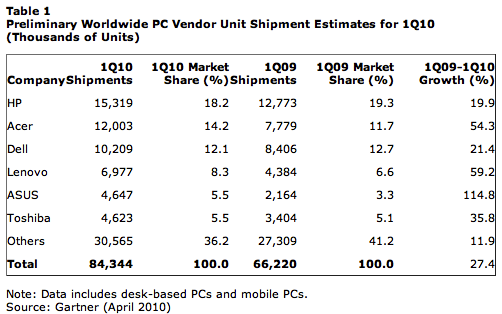
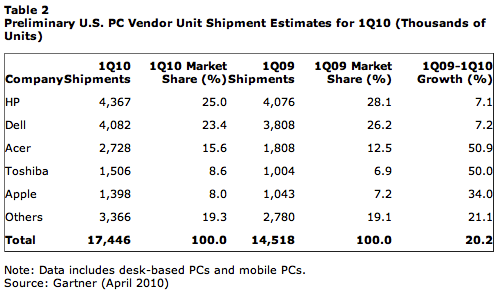
Worldwide, manufacturers shipped 84.3 million PCs during the quarter, according to Gartner. While HP led with 15.3 million PCs in Q1, every other manufacturer in the top five posted stronger growth — 114.8 percent for ASUS and 59.2 percent for Lenovo, according to Gartner. US PC shipments were 17.4 million units, with Acer and Toshiba both growing about 50 percent. Apple shipped 1.4 million computers, for 34 percent year-over-year growth. However, IDC put Apple shipments lower, at 1.1 million, with growth a much lower 8.3 percent.
Apple ranked fifth in the United States, falling yet another place, with 8 percent market share, down 7.2 percent year over year, according to Gartner. But IDC reported that Apple’s market share declined to 6.4 percent, from 7.2 percent. Just two years ago, Apple had risen to third place in US PC shipments. However, despite all the hoopla about increasing Mac sales, Apple US ranking declined, with risk the company might fall back out of the top five in some future quarter.
Gartner and IDC won’t tabulate Apple’s worldwide ranking until the final figures are released, and generally the information is not publicly available. But the last time I could get data, Q3 2009, Apple ranked No. 7 in worldwide PC market share, according to IDC.
Apple is scheduled to announce second fiscal quarter earnings on April 20. Already, Wall Street consensus is for about 3 million Macs shipped worldwide, which would be on par with the last couple of quarters (3.3 million in the holiday quarter and 3.05 million in calendar Q3 2009). In the year-ago quarter, Apple shipped 2.2 million Macs.
While these numbers are good Apple-on-Apple, recovery of the larger PC market bodes better for competitors. Increases in business sales, particularly those driven by Windows 7 upgrades, will favor Microsoft and its OEM partners. Apple still plays more strongly to consumers, which in part is by design. While Apple markets Macs to businesses, the focus is more on niches, such as content creators; the broader emphasis is the consumer buyer.
Additionally, Apple doesn’t much compete for sales below $1,000, where there are larger volumes. So as a measure of unit sales, Apple’s ranking will likely continue to decline. However, Apple likely will continue to maintain high revenue share in the premium PC market, which is about 90 percent at US retail.
Regina teacher charged with sex offences
An award-winning Regina high school teacher, basketball and football coach has been charged with six sex offences involving teenage boys.
Google’s Insane Number of Servers Visualized [Google]

You already just sort of know, logically and instinctively, that Google’s got a ridiculous number of servers working for them. That doesn’t make it any less mind-boggling when visualized. Get ready for a lot of scrolling. More »