Yawnlog Tracks Your Sleep Habits, Helps You Pinpoint Problems [Health]

Sometimes the best way to find behavior patterns is to plot them out on a graph. Yawnlog helps identify your sleep problems by displaying your snooze data in chart-form.

To get started with the web-based sleep tracking service, sign up for a free account. You can start entering sleep data right away, including backdating entries to include info from nights past. Record the approximate time you fell asleep, the time you woke up, and the quality of your sleep each night; Yawnlog will do the rest. You can even add notes to each entry if you want to keep track of variables like how medication you’re taking might be affecting your slumber.

Yawnlog gives you an overview of your daily and average sleep debt (if any), as well as an average of how much you sleep per night and how close you are to meeting your nightly sleep goals. To see how your numbers compare, Yawnlog lets you connect with other users so you can see how much sleep time you get compared to your friends. You can make your profile and data public so others can find you, or mark it private so it’s accessible only to you.

Yawnlog isn’t as robust as some of the other sleep tracking apps we’ve mentioned, but it’s a great way to get some insight into what affects your sleep and what kinds of overall slumber habits you’re developing.


Xbox Live May Kill Cable With Live Streaming Sports From ESPN [Xbox Live]

While you never necessarily needed cable, the one gap in internet video service has always been the lack of live sports. According to the NY Times, Microsoft and Disney are looking to change that, bringing ESPN to your Xbox Live.

Xbox Live users can already access dated content via Netflix, but this move towards live streaming would be a major one towards killing off cable once and for all. Especially since it targets a dedicated audience (sports fans) that has significant overlap with Xbox Live’s built-in gaming community.

The set-up would be similar to that of ESPN 360, which is already available from some ISPs. It would be based on a per-subscriber fee, and would include live streams of sporting events and possibly also interactive games that incorporate the ESPN brand. We’ll update with more details if and when they’re available. [NY Times]


Now You Can See Through Buildings Like Batman Bin Suparman [Augmented Reality]

Taking a hint from how the F-35 demon helmet maps multiple video feeds into a 3D space, a Carnegie Mellon University team has created an augmented reality car system to see through any massive obstacle. The objective: Avoid car collisions.

The system takes video from two cameras and mixes them into one, creating the illusion of being able to see through any object. A video processing system compares the feed from one of the cameras—installed in the car—to the other camera—installed on a street. By identifying common points between the two sources, the software can distort the street camera's video feed to match the driver's view. The matching perspective video gets projected onto the windshield, allowing the driver to see through walls in a natural, seamless way.

The Carnegie Mellon team, lead by Yaser Sheikh, thinks that the system could be easily implemented by tapping into the CCTV camera networks available in most major cities.

I’m glad to see that someone is thinking about making CCTV useful for everyone. On the other side, I wonder why people spend time creating these absurdly useful, accident-preventing augmented reality systems, instead of working in making a software like iNaked (NSFW) a reality. Get on the with the program, people. You need to get your preferences right. [New Scientist—Thanks Jimmy Flores]


Learning Windows 7: Manage Power Settings

In XP you probably already know how to manage the power settings for your system on a laptop or desktop. Today we take you through how to manage power settings and create custom plans in Windows 7.

There are new power management options that you can set up in Windows 7 compared to XP. You might want to change plans to save battery power on your laptop, or reduce energy consumption on a desktop at home or the office. Here we will look at how to manage and tweak the power plans, and how to create custom plans as well.

Power Settings

To access power plan options, type power settings into the search bar in the Start Menu and hit Enter.

1power

The Power Options screen opens and from here you can select from three predefined plans–Balanced, Power saver, or High performance.

2power

Click on Choose what the power button does and you can tweak several options such as Requiring a password on wakeup and what the power button on the computer does. If you set When I press the power button to Do nothing, you won’t have a problem with the PC shutting down when you accidently hit the power button.

11power

To change any one of the predefined power plans click on Change plan settings.

3power

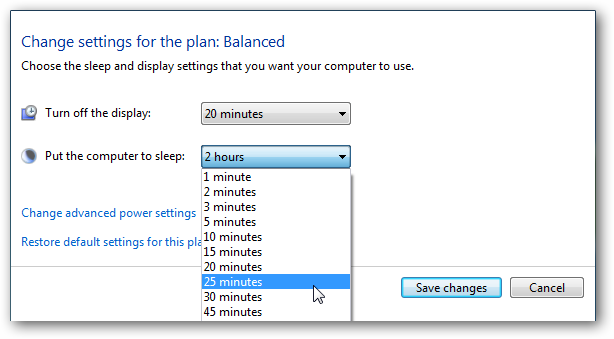
Then you can change the amount of inactive time before the monitor is turned off or the computer goes into Sleep mode.

4power 

If you want to revert back to the default settings, simply click on Restore default settings for this plan.

6power

Custom Power Plan

To create a custom plan, click on Create a power plan from the Power Options section.

7power

In the Create a power plan window a predetermined plan that is closest to what you want, and give the plan a name.

8power

In the next screen select the sleep and display settings you want to use and click the Create button.

9power

After your plan is created you’ll see it under the preferred plans list.

10power

If you click on Change advanced power settings, there are several options you can tweak. These settings should only be used by advanced users, as if you turn off the wrong thing, your computer may not function correctly. Choosing between the predetermined settings should be adequate for most users.

5power

If you are having issues where your laptop is draining too much battery power, or you want to check the overall efficiency of power usage on your computer, check out our article Use PowerCfg in Windows 7 to Evaluate Power Efficiency.

sshot-2010-01-14-[21-59-31]

Conclusion

Windows 7 makes it easy to manage power settings for different computing situations. If you find your computer mysteriously shutting down or going into sleep mode, this should also help you determine why it is happening.

We also have a few other articles related to power management in Windows you might be interested in:

Disable Power Management On Windows 7 or Vista

Create a Shortcut or Hotkey to Switch Power Plans

Change the Windows 7 or Vista Power Buttons to Shutdown/Sleep/Hibernate

Got an opinion to share? Click here to join the discussion

Similar Articles Productive Geek Tips
Latest Software Reviews Tinyhacker Random Tips

Google makes HTTPS default for Gmail

Google has announced on the Official Gmail Blog that they have begun rolling out default https settings to all Gmail accounts. For users that don't want this setting, or if it causes some sort of connectivity issues through someone's firewall, the feature can always be disabled. Here's how it will work… "If you've previously set your own https preference from Gmail Settings, nothing will change for your account. If you trust the security of your network and don't want default https turned on for performance reasons, you can turn it off at any time by choosing 'Don't always use https' from the Settings menu." Google is doing this to protect people's private data from being sniffed by third parties.

Read full story…

Gmail Making Secure Https Connections a Default [Security]

Gmail has long offered a more secure connection option over Https, and two years ago let users set it themselves as a default. Now Google is making https the default setting for all Gmail accounts, unless you flip it back.

Given their recent security episode in China, and the ever-expanding realm of devices and portals users can get at Gmail from, it’s probably a smart step forward to gently goad users into using a more secure connection standard. Google notes that, although using https creates a slight latency, they believe the trade-off is worth it.

If https presents a problem in your particular IT environment, you can still switch it off in your Settings. Here’s Google’s explanation:

If you’ve previously set your own https preference from Gmail Settings, nothing will change for your account. If you trust the security of your network and don’t want default https turned on for performance reasons, you can turn it off at any time by choosing “Don’t always use https” from the Settings menu. Gmail will still always encrypt the login page to protect your password. Google Apps users whose admins have not already defaulted their entire domains to https will have the same option.

Google also notes that Offline Gmail users who weren’t already using https as a default may see some issues, but they suggest a work-around.

Does a default https present problems for your own Gmail account? Happy to see the security struggle moving a step forward? Tell us your take in the comments.

Default https access for Gmail [Official Gmail Blog]


Facebook Adds Comment Reply by Email [Social Networking]

Frequent Facebook users get a handful of emails from the social networking service every day alerting them of new comments, but replying to these comments always required clicking over to Facebook—until now. Facebook users can now respond directly to comments via email. Handy—especially for folks whose workplaces block the 'book. [Facebook Blog]


Best DVD-Ripping Tool: Handbrake [Hive Five Followup]

It’s frustrating to not be able to get your DVDs onto your portable devices or media server. Last week we looked at the best tools for ripping your DVD collection and we’re back to announce the winner.

Handbrake led by a healthy margin and took home 34% of the vote and with good reason. It’s free, cross-platform, and has grown easier to use with each new release. Following Handbrake was DVD Shrink">DVD Shrink (23%) and DVD Fab">DVD Fab (15%). Rounding out the Hive Five was AnyDVD (11%) and DVD Decrypter (13%). It’s worth noting that as awesome as Handbrake is, it doesn’t include any tools for actually circumventing DVD encryption, so you’ll need to pair it with one of the other solutions in the Hive Five. Check out the full Hive for additional information about each contender.

Have a topic you’d love to see covered by the Hive Five? Send us an email at tips @ lifehacker.com with “Hive Five” in the subject line and we’ll add it to the list!


iTunes pricing is out of control

By Joe Wilcox, Betanews

Succinctly stated: You pay more.

Apple has a reputation for charging more for most everything, while often delivering less than competitors. Any Windows PC-to-Mac laptop pricing comparison is example enough. The Windows computer typically comes with higher-resolution display, more system memory and beefier storage than comparatively-priced Mac portable.

However, iTunes store has long been the exception to Apple higher pricing. Right from its Spring 2003 opening, iTunes store offered affordable singles and albums — hey, who could complain about 99 cents or $9.99, respectively? But recently, iTunes pricing has gotten wicked crazy, following last year’s institution of variable pricing. I got to taste the insanity early this afternoon, when finding a new album selling for about 8 bucks more for the iTunes digital download than the CD sold by Amazon.

What the frak?

Is It Rain or Shine?

It’s New Music Tuesday, when I rush online to survey the releases. O.A.R. has a new live album, “Rain or Shine,” which immediately caught my attention. But my enthusiasm skidded to a halt when looking at the iTunes price: $24.99. Yeah, there are 37 tracks, but 25 bucks — or $1.29 per track? At the per-track price, the album would cost more than $49. For the full album, per-track price savings, someone else might bow before the great Apple god in gratitude. I’m an ingrate. I looked to AmazonMP3 for a better price — and couldn’t find it. Amazon’s digital download store doesn’t list the album. But the retailer carries the CD, with all 37 songs for $16.99. That’s 5 bucks off the list price, which is still less than what iTunes charges.

Apple isn’t just charging more, it’s doing so for a comparatively inferior product. Music fans can argue the merits of AmazonMP3’s 256kbps MP3 encoding compared to Apple’s 256kbps AAC. But there’s no argument about lossless, uncompressed Compact Disc Digital Audio format and its 1,411kbps bitrate.

I’ve known for sometime that iTunes charges more than AmazonMP3 for many albums or singles, but this was my first encounter with pricing substantially above a CD. In April 2009, when Apple instituted variable pricing, I blogged: “What Apple Variable Pricing Means to You.” I did numerous pay-more comparisons between AmazonMP3 and iTunes stores. Apple pay-more pricing was already in effect for most newer or popular tracks.

I wondered if perhaps “Rain or Shine” is a fluke, which is how I came to write this post. The first question: Does Amazon offer the album for substantially less than other retailers? Answer: No. F.Y.E. lists “Rain or Shine” for $14.99, but store club members only pay $13.49. Holy Heck, Batman, not only does the music retailer charge $2 to $3.50 less than Amazon, but $10 to $11.50 less than iTunes!

Apple’s Pay-More Pricing

What about other albums? Black Eyed Peas’ “The E.N.D.” is $10.99 from iTunes. Amazon sells the CD for $9.49. However, CD buyers get a $3 AmazonMP3 store song credit, effectively lowering the price to $6.49. Whoa, Amazon’s digital download version of “The E.N.D.” is only $5.99, or four bucks less than iTunes. Apple charges $1.29 for each individual track, compared to 99 cents each from AmazonMP3.

O.A.R. "Rain or Shine"

Deluxe version of Lady GaGa’s “The Fame Monster” costs $13.99 at iTunes for 24 tracks. Amazon charges $14.99 for the 22-track CD or $11.99 for the digital download album. So iTunes is the sweeter deal, right? Maybe not. People buying the CD get a $3 credit for AmazonMP3 store, effectively reducing cost of “Fame Monster” to $11.99 — two bucks and two tracks less than iTunes. Another cost difference: iTunes again charges $1.29 for each individually purchased track from “Fame Monster,” and the two additional tracks are only available with the album purchase. By comparison, AmazonMP3 charges 99 cents a track.

Owl City album “Ocean Eyes” is $9.99 from iTunes with two additional tracks available only with the album version. Amazon charges the same price for the 12-track CD, but the $3 AmazonMP3 store credit effectively reduces the price to $6.99. However, AmazonMP3 charges even less, only 6 bucks for digital download version of “Ocean Eyes.” Once again, Apple charges a buck twenty-nine for individual tracks compared to AmazonMP3’s more appealing 99 cents.

Apple’s music pricing isn’t all bad. Ke$ha’s “Animal” is $6.99 from iTunes or AmazonMP3, and both digital download stores charge $1.29 for each individual track. Amazon sells the CD for $7.99. However, Amazon offers $3 digital download credit for “Animal,” effectively lowering the price to $4.99.

Pay More, Pay Less

Black Eyed Peas "The E.N.D."I’ve long observed that Apple justifies charging more by offering a little more — and sometimes less than competing stores. It’s Marketing 101 stuff. For example, OneRepublic’s “Waking Up (Deluxe Version)” is $12.99 from iTunes for 15 tracks (the standard album has 11 songs). Amazon and F.Y.E. don’t offer this version of the CD, which Amazon partners sell for $17.99 or more. So, iTunes is the cheaper option. However, Amazon sells the “Waking Up” non-deluxe CD for $7.99, or $2 less than iTunes. Once again, Amazon’s $3 song credit applies, effectively reducing the album’s cost to $4.99. Amazon’s digital download version costs $5, with 12th track “Mercy,” which isn’t available from iTunes. Once again, Apple charges $1.29 for each individual track and Amazon just 99 cents. So the standard album or singles cost more from iTunes.

In comments, someone is sure to assert that Amazon tax and shipping raises CD-to-digital download pricing in Apple’s favor. Amazon doesn’t charge tax in most states and offers a free 3-to-5 day shipping option. However, Amazon’s Prime service, which costs $79 a year, provides free two-day shipping or one-day shipping for an extra $3.99 per item. Prime can be shared with four separate accounts, so if you’ve got roomies or family members the annual fee is effectively less. I love Prime.

There’s no point paying Apple more when there are cheaper alternatives. I regularly buy songs from iTunes store, but typically find better prices — and more aggressive daily deals — from AmazonMP3. But following today’s surprising cost comparison for “Rain or Shine,” I’ll consider more CDs compared to digital albums, particularly those sold by iTunes. I ordered the new O.A.R. CD from Amazon while writing this post but before checking F.Y.E. pricing. Even $16.99 was too much to pay, although that $3 credit helps soften the extra paid to Amazon over F.Y.E.

Should you pay more?

Copyright Betanews, Inc. 2010


Add to digg
Add to Google
Add to Slashdot
Add to Twitter
Add to del.icio.us
Add to Facebook
Add to Technorati


Frequently Asked Questions About Google Wave [Faq]

The Google Wave Preview has been available to one million+ people for over three months now, but questions about Wave still abound, even by the early adopters who have gotten in and taken it for a test drive.

After publishing a book on everything I know about Wave, I still get many of the same questions I heard back when I started. Even folks usually bullish about new technology still don’t understand what they can use Wave for, how to sell it to their friends and co-workers so they have someone to use it with, and how to fit it into their workday.

As much as I’d love it if everyone bought a copy of my book for every person they invite to Wave, reading 102 pages just to “get” a product is ridiculous. So, I’ve compiled some of the most frequently asked questions I’ve gotten about Wave and my best (and briefest) answers for them right here in quick-fire format.

Step inside to hear a two-word definition of Wave, what it’s useful for, why you’d choose it over similar products, and how to do the things in Wave that most often trip up new users.

Q: How do you describe what Google Wave is in the fewest words possible?

A: Two words: Google Wave is multimedia wikichat.

Ok, I cheated a little. Wikichat is my made-up word for the combination of document collaboration (wikis) and messaging (chat). Imagine a Wikipedia page that only your workgroup can access and that multiple people can change simultaneously, with live, inline chat embedded in it and the ability to add online multimedia like an image slideshow, videos, maps, polls, a Sudoku game, video conference call, and other interactive widgets. See it? That’s Wave.

Q: Why would I use Wave instead of email?

A: You'd use Wave instead of email because you can have real-time, IM-like conversations inside it, and cut out the lag time of asynchronous email communication—you know, when you send an email and have to wait for your recipients to read, reply, and send one back. In Wave, if your recipient is online, you don't have to wait. In fact, your recipient can start typing before you stop. It's wacky.

Q: Then why would I use Wave instead of IM?

A: You’d use Wave instead of instant messenger because you can edit the same text, images, captions as someone else is at the same time. During an instant messenger conversation you pass back and forth a series of single-author, uneditable messages. In Wave, anyone can edit any message (or blip, in Wave-speak). Imagine correcting someone else’s typos during a chat yourself, without pointing out to them that they mistyped.

Wave also supports conversation threads, which means that instead of one linear discussion where new messages appear on top or below old ones, you can branch off sub-chats on different topics in one wave.

But mostly you use Wave to collaborate on a single copy of a document with multiple people at the same time.

Q: Then why would I use Wave instead of Google Docs?

A: GDocs is more like collaborative/web-based Microsoft Word, where the object is to create a flat file that gets printed or emailed to someone. Wave is more like a real-time wiki, which creates pages meant to be linked and constantly revised, pages that contain web-based multimedia and interactive gadgets.

In Wave you can drop multimedia like image slide shows, YouTube videos, Google Maps, and countless other gadgets that you can’t in Google Docs. Like a wiki (and unlike Google Docs), you can link waves to each other very easily.

Wave is more like a real-time, workgroup Wikipedia than Google Docs or email.

Q: So, what would I actually use Wave for?

A: Wave works when two or more people need to co-write a document. A few common use cases include:

  • collaborative meeting, conference, or class notes—whether or not everyone's in the same physical room, several people taking notes in one place is much more efficient than everyone taking their own individual notes
  • interviews—each question and answer series can be one thread within the parent interview thread, where the interviewer and interviewee can revise and expand questions and answers inline
  • group event planning, like a party, trip, wedding
  • co-writing and editing—whether it's books, blogs, brochures, policies
  • surveys
  • translations
  • project management

The following are questions I’ve gotten from people already in the Wave Preview, trying to figure out how to use the system.

Q: Now that I’ve gotten into the Preview, how do I invite other people in?

A: Search for a wave called “Invite others to Google Wave.” Enter title:"Invite others to Google Wave" into the search box, and press Enter. One wave with only you as a participant on it should turn up. In it, you can enter the email address of the folks you want to invite.

If no wave gets returned, be patient! Google may not have doled out nominations to you yet. Save your search to check back later by clicking the Save Search button on the bottom of the Search Panel.

Q: How do I use Wave if no one I know is ever online while I am?

A: To experience the real-time magic of Wave even if your friends aren’t online, search for public waves in action using the with:public search operator. Select a wave at the top of the list of results, and watch as others type into it—then jump in yourself.

Q: How do I make a wave public?

A: The easiest way is to use the Easy Public bot. Add easypublic@appspot.com to your Contact list, and then drag and drop it onto any wave to make it public.

Q: How do I see the next unread blip in a wave?

A: Press the Spacebar. In a big wave with lots of unread blips in various locations, the Spacebar will take you to the next unread blip in one press.

Q: How do I publish a wave in a blog post?

A: Right now the Madoqua Bot can give you the embed code for putting a wave on a public web page. Add Madoqua to your wave to get started.

Remember, though: the people viewing your blog post or web page will have to be logged into Wave to see the embedded wave. Otherwise they’ll just get a prompt to log into the Wave Preview, which is frustrating for people who aren’t in Wave yet.

Q: How do I remove a Wave contact?

A: To remove a contact from your Wave contacts list, you’ve got to do so in the regular Google Contacts interface. Click on the Manage contacts link at the bottom of Wave’s Contacts panel. Here’s how to remove a contact step-by-step.

Q: How do I remove a participant from a wave?

A: You can only remove bots from waves—not regular users. Yes, this is crazy and needs to be fixed stat. Here's more on the inability to remove participants from a wave.

Q: How do I link to another wave inside a wave?

A: You can create a link to a wave in another wave by simply dragging and dropping the destination wave from the search panel onto the linking wave while you’re editing it. Make sure all your participants have access to the linked wave, otherwise they won’t be able to open it.

To link to a wave outside of Google Wave, first open the wave then minimize your Search panel. Copy and paste the link in your browser's address bar—that link will open that wave with those panels minimized for anyone who clicks on it, is logged into Wave, and has access to that wave.

Q: How do I set my Google Wave icon?

A: Click on your name at the top of the Contacts panel. From the profile pop-up, click the Edit profile button. A special profile wave opens, and there you can upload an image that will appear as your icon whenever you participate in a wave or appear in others’ Contacts lists.

Q: How do I remove a gadget from a wave?

A: Hover over the gadget, and an arrow will appear on the top-right corner. Click it to view the drop-down and choose “Delete.”

Q: Since my friends and co-workers don’t use it every day, I forget to check my Wave inbox. How can I get notified when waves are updated without logging in?

The Google Wave Notifier (Windows only) is a system tray application that notifies you when you have unread blips in waves.

The Google Wave Add-on for Firefox notifies you of unread waves in Firefox’s status bar.


Now I’ve got questions for you. I’m working on the next edition of The Complete Guide to Google Wave, and I want to know: what do you want to see get added to the book? What burning questions did I miss here? How are you using Wave day-to-day—or what's stopping you from doing so? Post your thoughts in the comments, and thanks in advance for your help expanding the book.


GDrive Is Here-ish: Google Docs to Allow Users to Upload Any File-Type [Gdrive]

Google users will soon be able to upload any file type to Docs (as long as it's under 250MB)—as opposed to the very limited slate of document types currently supported (like images, Word docs, PDFs, spreadsheets, and PowerPoint presentations).

Photo from TechCrunch

Because Google Docs now supports files up to 250 MB in size, which is larger than the attachment limit on most email applications, you’ll be able to backup large graphics files, RAW photos, ZIP archives and much more to the cloud. More importantly, instead of carrying a USB drive, you can now use Google Docs as a more convenient option for accessing your files on different computers.

Tech news blog TechCrunch quotes Google Docs product manager Vijay Bangaru emphasizing that this is not the much speculated GDrive, but they appropriately point out that—regardless of what they're calling it—it sure sounds like the GDrive people were expecting. Users will get 1GB of free storage to hold whatever they want, and they can buy more storage space for $0.25 per GB.


Zune HD Firmware Update Bringing XviD and Streaming Playlists In Spring [Firmware]

A firmware update will bring two great features to the Zune HD this spring. The first is native XviD support, which is self-explanatory. The second requires just a tad more explanation.

The Smart DJ feature, now on the Zune's PC software, will make its way to the HD, offering on the fly track suggestions. That's OK—pretty similar to the iPod's Genius features—but what will make the feature great is that Smart DJ will also work over the Zune HD's Wi-Fi connection, allowing you to stream these suggested tracks from the cloud (instead of needing to have all that suggested music stored on the device already).

Good stuff. [CNET via SlashGear]


Strata40 Gives Firefox the 4.0 Look Ahead of Schedule [Downloads]

Windows/Linux (Firefox): Late last month, a Mozilla contributor showed us how Firefox 4.0 might look. The Strata40 theme and add-on gives your browser that same look, without having to wait or install pre-pre-alpha Firefox builds.

Strata40 and its required side add-on, StrataBuddy, offer many of the same tweaks to Firefox’s interface that Firefox 4.0 will likely offer, like moving your tabs to the top of the window or just under the address bar, consolidating the address and page loading bar, and updating the various graphical bits around the browser frame.

The top image shows off the developer’s own screenshot of his add-on in action. He’s got a nice-looking olive-type Windows theme going on; here’s how Strata40 looks installed on a stock Windows 7 copy of Firefox 3.5, with the tabs moved up top:

If you head into the StrataBuddy Options panel, you can enable the Aero Glass background style, which combined with the tabs moved to the top, and the menu bar hidden, looks like this:

The developer “requires” about three other add-ons to get Strata40 running “at its best,” like Fission, App Tabs, and Tab Progress Bar, and suggests that Firefox 3.6 is actually a better fit for his theme than 3.5. Still, with Strata40 installed, Firefox 3.5 can move forward in design time a bit without too much incompatibility risk or, seemingly, add-on drag.

Strata40 and StrataBuddy are free downloads, and StrataBuddy is an experimental add-on. Both work on Firefox 3.5 and 3.6 on Windows and Linux systems.

Strata40 [Firefox Add-Ons]


Sony to Reboot Spider-Man – Raimi Walks

Holy crap. I just got home and found out the news that Sam Raimi had enough of the Sony BS and put his foot down over the whole Vulture thing. Unfortunately for Sam, that foot went down on the sidewalk outside the studio.

Raimi has quit Spider-man 4 and he took his Scategories with him.

So where does that leave Sony and Spider-Man? Do you think they will move forward without him. Nope. Instead of just picking up where Raimi left off they are going to let that stink hang. Sony is rebooting the franchise and starting over fresh with a whole new team.

Deadline Hollywood set us up the bomb

Culver City, CA (January 11, 2010) — Peter Parker is going back to high school when the next Spider-Man hits theaters in the summer of 2012. Columbia Pictures and Marvel Studios announced today they are moving forward with a film based on a script by James Vanderbilt that focuses on a teenager grappling with both contemporary human problems and amazing super-human crises.

The new chapter in the Spider-Man franchise produced by Columbia, Marvel Studios and Avi Arad and Laura Ziskin, will have a new cast and filmmaking team. Spider-Man 4 was to have been released in 2011, but had not yet gone into production.

Wow, I just don’t see the benefit of doing this aside from Sony having a massive pressed ham at Raimi, cleaning the slate and moving forward.

As much as Spidey3 gets torched, I have to say as a whole, the series has been great. Sure, they could have done better than Kristen Dunst as the supermodel to be, and while I didn’t hate her – they could have done better. Still, one blip hardly justifies starting over. Not this soon. It just doesn’t feel right.

But one thing I am noticing in the midst of the nerdrage and cries against Sony for this unexpected move…

They can do Venom the right way now.