PlayStation Blu-ray 3D update arrives in September; 3D photo, PlayTV and YouTube support to follow

Just in case you weren’t really sure how deep into this 3DTV thing Sony is, senior director of Sony Europe Mick Hocking announced the PS3’s update for Blu-ray 3D movie playback will be released in September — but it won’t stop there. Expect future firmware upgrades that give the PS3 3D rendering for photos (.mpo files), any broadcasts it can pick up on PlayTV, and even YouTube videos. Not running out the door to buy one yet? CVG reports the rest of the presentation was devoted to extolling the virtues of 3D to hardcore gamers in racing games, God of War, or LittleBigPlanet. Demos so far haven’t completely convinced us the PS3 is capable of rendering games in high enough resolution to satisfy, but if Fat Princess 2 features a good 3D implementation, someone hide our credit cards, please.

Filed under: ,

PlayStation Blu-ray 3D update arrives in September; 3D photo, PlayTV and YouTube support to follow originally appeared on Engadget on Fri, 09 Jul 2010 16:26:00 EDT. Please see our terms for use of feeds.

Permalink   |  sourceCVG  | Email this | Comments

After five years, 64-bit editions of Windows make up nearly half of install base

By Tim Conneally, Betanews

64-bit editions of Windows have been available to OEMs and consumers for five years, and they have finally begun to exhibit command over the PC market, Microsoft reported today.

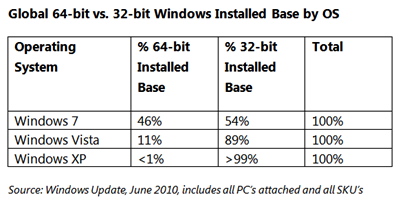
64-bit Windows install base June 2010

By June 2010, 46% of all PCs running Windows 7 were running the 64-bit edition. Three and a half years after Windows Vista launched, only 11% of users have installed the 64-bit version, considerably fewer than Microsoft claimed in 2008 when product manager Chris Flores told us “20% of new Windows Vista PCs in the U.S. connecting to the Windows Update were 64-bit…”

Irrespective of Vista’s performance, Microsoft evangelist Chris LeBlanc says there are certain factors contributing to the growth of 64-bit editions right now.

First, the cost of memory has dropped significantly in the last five years, a majority of processors are 64-bit enabled, and more compatible hardware and software is available today. Secondly, companies such as Intel are upgrading their internal systems to the 64-bit architecture.

Gartner predicted last year that as much as 75% of all enterprise PCs will be running 64-bit editions of Windows by 2014.

“On the surface, it would appear that the most obvious time to perform a move from 32-bit to 64-bit would be during an operating system migration (such as from Windows XP to Windows 7). Many companies feel that, if they don’t make the move now, they may have to wait until Windows 8 or potentially Windows 9 before another opportunity arises,” Gartner’s research said.

Copyright Betanews, Inc. 2010


Add to digg
Add to Google
Add to Slashdot
Add to Twitter
Add to del.icio.us
Add to Facebook
Add to Technorati


Windows VistaMicrosoftOperating systemMicrosoft WindowsWindows XP

aCircuit Board live wallpaper is aMazing (video)

Like teardowns? Ever worn a loose resistor in your pierced 80s earhole just to show the world how geek-punk you really are? Man, have we got the Android Live Wallpaper for you. aCircuit Board is a ¥99 (a bit more than a US buck) animated wallpaper available on the Android Market. Moving fan; binary clock; GPS, WiFi, and Bluetooth status lights; a pulsating Android bot; and active circuit paths depending upon where you touch the PCB. Of course, it's all configurable too, via the options menu. Buy hey, don't take our word for it, see it in action after the break.

Continue reading aCircuit Board live wallpaper is aMazing (video)

aCircuit Board live wallpaper is aMazing (video) originally appeared on Engadget on Fri, 09 Jul 2010 07:20:00 EDT. Please see our terms for use of feeds.

Permalink   |  sourcePocketNow  | Email this | Comments

ComScore: Android grows US smartphone market share as all others decline

Slip on your fine silk smoking jacket and light up a victory cigar US Android fans, the latest comScore numbers are out for the three-month period ending in May 2010. The most notable trend spotted was a 4 point (up from 9.0% to 13.0%) quarterly increase in Google’s Android market share as all other smartphone OS subscribers declined. ComScore also saw Motorola’s slide continue, slipping behind LG now for a third place US finish as Samsung continued to bolster its dominant position. Expect the numbers to be jostled a bit next quarter when Apple’s iPhone 4 numbers are factored in. Just don’t expect to see the Android numbers suffer, especially with the Samsung Galaxy S launching on all the major US carriers before the quarter is done.

[Thanks, Jeremy]

ComScore: Android grows US smartphone market share as all others decline originally appeared on Engadget on Fri, 09 Jul 2010 02:17:00 EDT. Please see our terms for use of feeds.

Permalink   |  sourcePRNewswire  | Email this | Comments

Rich text signatures

Posted by Mark Knichel, Software Engineer

Rich text signatures have long been one of our most widely requested features. Some of you have tried your own solutions, including Greasemonkey scripts, browser plugins, and even using canned responses from Gmail Labs. Others have simply lived with frustration of not being able to change the colors or font size of your signature, or insert images and links. Either way, you’ll be happy to know that today we’re launching the ability to write your own rich text signatures right in Gmail.


The next time you log in and visit the Settings page, you'll see a rich text editor in the signature section. Here, you can customize your signature by adding pretty formatting, links, and images — or decide to leave things nice and simple.

Gmail also now supports a unique signature for each email address associated with your account. So, if you send mail using a custom “From:” address, you can use a different signature for that address. From the Settings page, you can edit the signature for each account by changing the email address that appears in the dropdown menu.


Currently, only the latest desktop version of Gmail supports rich text signatures and multiple signatures. The older version and HTML version of Gmail, along with the mobile versions, use a plain text version of your primary account’s signature.

Telescopic eye implant approved by the FDA

We love eye implants, and we’ve seen our share of them, and this one is pretty sweet (although it isn’t the creepiest by a long shot — that prize would go to the one that uses a human tooth to hold its lens). In the works for well over a year, and approved by the FDA a couple days ago, VisionCare Ophthalmic Technologies’ implantable miniature telescope is intended for patients over 75 years of age who are suffering from end-stage macular degeneration. As with any tricky new surgery, this one is not without risks, including the need for a corneal transplant due to the device’s size. According to CBC News, in clinical testing seventy-five percent of over 200 patients “had their vision improve from severe or profound impairment to moderate impairment,” and there are two more studies on the way: one will follow up with existing patients, while the other will outfit 770 new patients with the device. The cost? $15,000.

Telescopic eye implant approved by the FDA originally appeared on Engadget on Thu, 08 Jul 2010 13:29:00 EDT. Please see our terms for use of feeds.

Permalink   |  sourceCBC News  | Email this | Comments

Microsoft: Kinect Will Work While Sitting – Seriously

kinect thumb Microsoft: Kinect Will Work While Sitting   Seriously

Representatives from Microsoft confirmed to Joystiq that its new Kinect technology for Xbox 360 will work while sitting – a point of contention since Kinect was unveiled at E3 2010.

During its tech demos, Microsoft demonstrated using the motion-control interface to play games in a standing position – dancing around, fighting with lightsabers, and whatever else you might expect.

But from the outset, it appeared as if the only way to make Kinect work was to use it in a standing position, which had a lot of lazy people upset. Plus it just didn’t sound very practical. But according to Microsoft, as long as a developer designs a Kinect game to work while sitting, it should.

Scrolling through menus, watching movies, hitting the Xbox dashboard – all that stuff will work from the couch. If Microsoft knows what’s good for it, it’ll make sure Kinect works with a bag of Cheetos lying on your chest, too.

Via Joystiq.

Share and Enjoy:Digg Facebook N4G Reddit Twitter

Yorkton still mopping up after flood

Yorkton residents are continuing to mop up almost a week after heavy rain inundated 1,000 basements, forced 175 people from their homes, and seriously damaged more than 20 local businesses.

YouTube Mobile Gets a Kick Start

(Cross-posted with the YouTube Blog)

It’s well known that the mobile internet is huge and growing fast; what’s surprising is exactly how fast. According to a recent report, within 5 years more users will connect to the internet via mobile devices than desktop PCs. YouTube consumption on mobile devices has also grown considerably — playbacks were up 160% in 2009 over the previous year. And we’re excited to announce that YouTube Mobile now receives more than 100 million video playbacks a day. This is roughly the number of daily playbacks that YouTube.com was streaming when we joined forces with Google in 2006.

We launched YouTube on mobile devices in 2007 with about 1,000 videos available on the mobile site (m.youtube.com). While this suddenly opened up the possibility to access videos on the go, our site, mobile browsers and the hardware had limitations that prevented the mobile experience from keeping up with YouTube on the desktop. Today, more than ever, we know that you want to be able to find and access your favorite videos wherever you are. That’s why we’ve been working hard to roll out an updated version of the mobile site.

Here’s what’s new about the new mobile site:

  • It’s really fast.
  • The new user interface incorporates larger, more touch friendly elements, making it easier to access videos on the go.
  • It incorporates the features and functionality you’ve come to expect from the .com site, like search query suggestions, the options to create playlists,the ability to designate “favorite,” “like,” or “unlike” videos directly from your device.
  • As we make improvements to Youtube.com, you’ll see them quickly follow on our mobile site, unlike native apps which are not updated as frequently.

As the world continues to go mobile, we think this is a great improvement for users who want a more consistent YouTube across many devices, no matter where they are. We’re launching in English only today, but will be rolling it out in other languages in the coming months. You can access the latest YouTube mobile site from your iPhone or Android browser. To learn more, visit m.youtube.com to check out the latest improvements and take a minute to watch this demo video:

Posted by Andrey Doronichev, Product Manager recently watched “Insane street football