Ballmer: next release of Windows will be Microsoft’s ‘riskiest product bet’ (video)

Windows 7 might be a massive commercial success and an undeniably rock solid piece of software, but Microsoft is apparently unwilling to rest on those soft and cozy laurels. Asked about the riskiest product bet the Redmond crew is currently developing, its fearless leader Steve Ballmer took no time in answering “the next release of Windows.” His interviewers sadly failed to probe any deeper on the subject, but it might be notable that Steve calls it the next release rather than simply Windows 8, while the idea of it being risky also ties in with previous indications that Microsoft is aiming for a revolutionary leap between iterations. We’ll have to just be patient and wait for more on that, though if you’d like a peek at Steve dodging question on tablets and the potential for Windows Phone 7 appearing on them, you need only jump past the break for the video.

Update: It’s also worth noting that Ballmer may not have been talking about revolutionary leaps as much as he’s referencing the past issues the company has had when it’s issued a major OS update (hello, Vista). The idea that making any big change to the operating system most of the world runs would invite a certain amount of high risk makes sense to us.

Continue reading Ballmer: next release of Windows will be Microsoft’s ‘riskiest product bet’ (video)

Ballmer: next release of Windows will be Microsoft’s ‘riskiest product bet’ (video) originally appeared on Engadget on Sat, 23 Oct 2010 11:01:00 EDT. Please see our terms for use of feeds.

Permalink Gizmodo, ZDNet  |  sourceGartnervideo (YouTube)  | Email this | Comments

Apple responds on missing Flash in new MacBook Airs, says get used to it

The other day, we reported on the fact that those tiny new MacBook Airs are shipping without a pre-installed version of Flash. Based on Apple’s recent, vocal anti-Flash opinions, we took it as a sign that the company was putting even more distance between itself and Adobe, but according to a statement we’ve just received, that might not be the case. Apple spokesman Bill Evans just pinged us with the official word on the situation, claiming that it has more to do with making sure users have the most recent version of the software and less to do with politics. Here’s the word from Apple:

We’re happy to continue to support Flash on the Mac, and the best way for users to always have the most up to date and secure version is to download it directly from Adobe.

Interestingly, he also notes that this will be happening across all Macs in the future, though there may be some models still in the channel with Flash pre-installed. Obviously this makes some sense, but it’s hard not to see it as a dig against Adobe — there must be other solutions for ensuring users are up to date (like, oh, putting the plugin into your auto-updater). Also, it would be nice if those “missing plug-in” messages actually worked as links to the Adobe install page (because they don’t, at least in Safari). Hey — at least we know it wasn’t a fluke!

Apple responds on missing Flash in new MacBook Airs, says get used to it originally appeared on Engadget on Fri, 22 Oct 2010 11:35:00 EDT. Please see our terms for use of feeds.

Permalink   |   | Email this | Comments

HP Slate 500 finally (finally!) official, rings up at $799

Nope, you’re not dreaming, but feel free to pinch yourself, rub your eyes or take a cold shower! You’ve read right — the HP Slate is finally official, and after all the teasing, back and forth, and (very recent) leaks, the Atom-powered, Windows 7 Slate will finally see the light of day — though in a different way than originally intended. While the first videos released by HP may have made it seem like it would be for consumers, HP’s tactfully changed its tune (don’t forget it’s got Palm / WebOS tablets on the way) and is now aiming the Slate at the enterprise and business market. Still, it will be available on HP’s site for $799 to anyone who wishes to purchase one.

So, what does $800 of your hard earned cash buy you? Well, in addition to the dock and case, which are included in the box, the tablet packs pretty much everything we’d heard over the last year — it’s powered by a 1.86GHz Intel Atom Z540 processor, 2GB of RAM, 64GB SSD and packs Broadcom’s Crystal HD accelerator for handling 1080p video. (The included dock has an HDMI-out port if you want to hook it up to the big screen.) Obviously, the 8.9-inch capacitive touch Slate runs Windows 7 Professional, but it’s got a Wacom N-Trig active digitizer for taking notes, which certainly sets it apart from the other Win 7 tablets we’ve seen over the last couple of weeks. Oh, and don’t forget its front facing VGA cam and 3 megapixel camera on its back. We got a chance to finally grope the tablet earlier this week, so hit the break for our early impressions and a short video.

Continue reading HP Slate 500 finally (finally!) official, rings up at $799

HP Slate 500 finally (finally!) official, rings up at $799 originally appeared on Engadget on Thu, 21 Oct 2010 20:19:00 EDT. Please see our terms for use of feeds.

Permalink   |  sourceHP  | Email this | Comments

Boxee Box shipping November 10th in US and Canada

And with that, the long (long!) wait is (just) about over. Boxee just announced this morning that its long awaited Boxee Box (you know, the one built by D-Link) will be shipping out on November 10th for customers who have pre-ordered from Amazon in the United States and Best Buy or Future Shop in Canada. Furthermore, pre-orders taken in Australia / New Zealand and other nations across Europe will start heading out “shortly thereafter.” For those looking to pick one up after the initial rush, it’s expected to start splashing down in retail on November 17th. So, you in?

Continue reading Boxee Box shipping November 10th in US and Canada

Boxee Box shipping November 10th in US and Canada originally appeared on Engadget on Wed, 20 Oct 2010 12:40:00 EDT. Please see our terms for use of feeds.

Permalink   |  sourceBoxee  | Email this | Comments

Android 3.0 due to start hitting tablets in December ahead of January launch

Android 3.0 due to start hitting tablets in December, launch in JanuaryA holiday tradition? Making things out of gingerbread, and Google is doing its part to keep that practice alive according to a report stating Android 3.0 is set to hit some tablets this December. Those will just be early samples destined only to light up the eyes of engineers who’ve been very, very good this year, but the rest of us naughty boys and girls will get to see those slates when they launch to the public in January. We hear there’s a little electronics show happening that time of year, and supposedly HTC, Samsung, and Motorola will be showing their Gingerbread tablets there, amongst others (but not Lenovo, apparently). We can’t wait to get a taste.

Update: Thanks to James for pointing out that it’s still unclear whether 3.0 is going to be Gingerbread or, indeed, the truly tablet-minded Honeycomb release we’re really waiting for. This report states specifically that 3.0 is hitting tablets in December, with 4.0 later in 2011. Is that Gingerbread and Honeycomb, or Honeycomb and Ice Cream? Also, is anyone else hungry?

Android 3.0 due to start hitting tablets in December ahead of January launch originally appeared on Engadget on Wed, 20 Oct 2010 12:21:00 EDT. Please see our terms for use of feeds.

Permalink   |  sourceDigiTimes  | Email this | Comments

Lenovo says no Android tablet in US until Honeycomb; no Windows 7 tablet, period

If you happen to be enthusiastic about Lenovo, tablets, and your American residency, look away now. Lenovo still plans to ship the Android-based LePad in China some time soonish, but its US roadmap can pretty much be summed up as “wait and see.” The company’s COO Rory Read has been cited as saying there are no plans to release a slate for the US market until at least Android’s Honeycomb version comes out, agreeing with Google on the point that Froyo is not “the right base to have a fully functioning pad.” Lest you think Windows 7 will fill the void until whenever in 2011 that Android tablet does arrive, Lenovo’s director of new technology, Howard Locker, sets you straight: “Windows 7 is based on the same paradigm as 1985 — it’s really an interface that’s optimized for a mouse and keyboard,” and the Thinking machine team doesn’t intend to build a slate around it. And if you were thinking of maybe picking up a LePhone as a consolation prize, tough luck, that won’t be arriving in the US for at least another two years (which in smartphone terms is basically “never”), although it’s good to know that it’s now got 13 percent of the smartphone market in China. You know, in case you own stock in LeCompany.

Lenovo says no Android tablet in US until Honeycomb; no Windows 7 tablet, period originally appeared on Engadget on Wed, 20 Oct 2010 05:26:00 EDT. Please see our terms for use of feeds.

Permalink   |  sourcePC Magazine  | Email this | Comments

Drag and drop images in documents

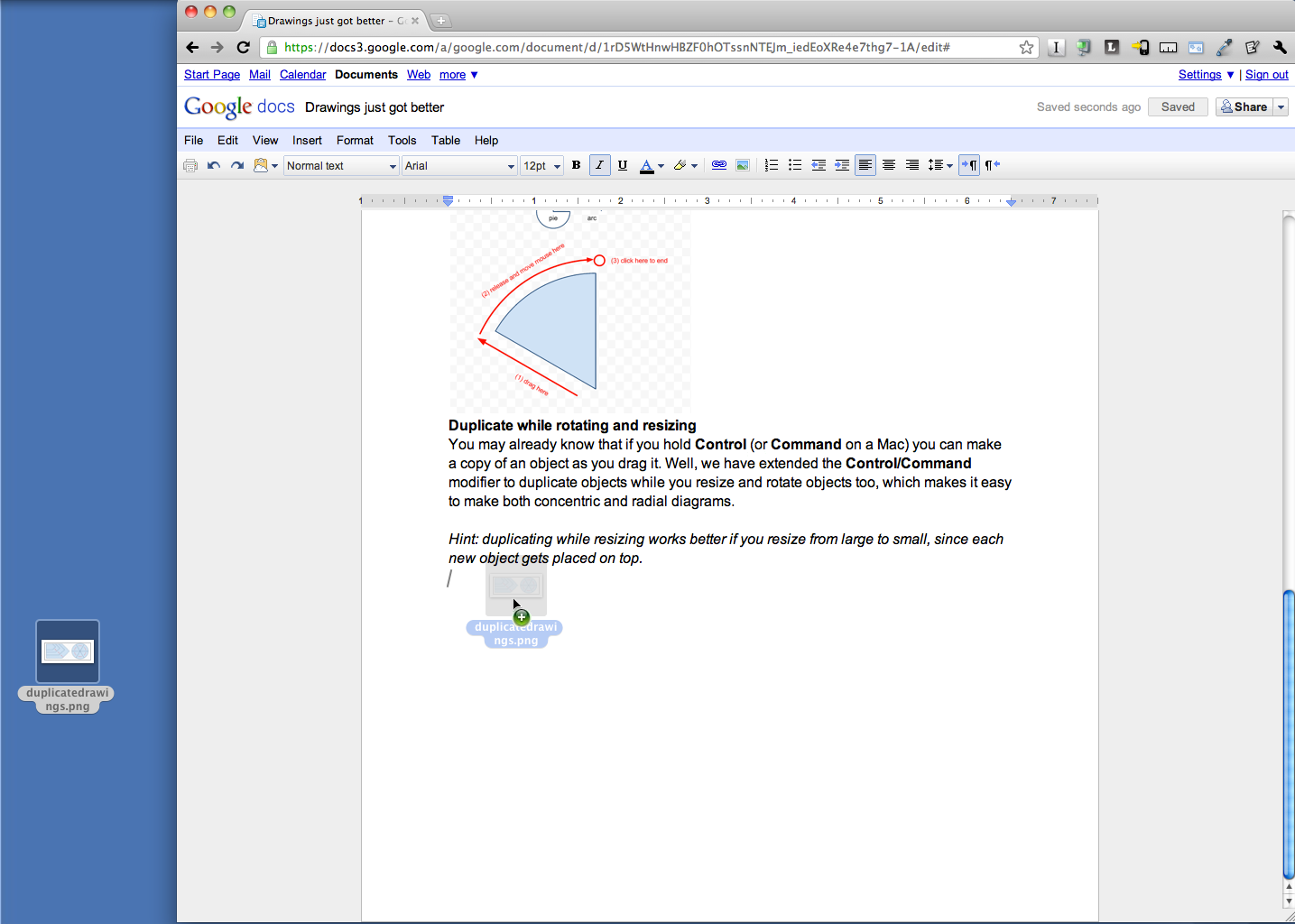
When writing a document, it often helps to augment text with images and diagrams. Google documents already has three ways to add images: you can choose them from your hard-drive, add them by URL, and you can find them using Google Image Search.

But sometimes the exact image you need is on your desktop and you just want to add it to your document quickly. Starting today, you can drag images from your desktop directly into your documents.


For now, you can use image drag and drop with the latest versions of Google Chrome, Firefox, and Safari. We’ll enable it on other browsers as soon as they support the feature.

Posted by: Philipp Weis, Software Engineering Intern

Windows Embedded Automotive hits version 7, powers Nissan Leaf, takes MyFord global

Microsoft's Windows Embedded Automotive hits version 7, powers the Nissan Leaf, takes MyFord global

We know how patiently you’ve been waiting for this day, but it’s here. It’s really here. Microsoft Windows Embedded Automotive 7 is out, appearing in the download queues of “select car makers and suppliers in the automotive industry.” What does it offer? Why, Silverlight support for fancier UIs, real-time text-to-speech technology, and better expandability for third-party plugins. In bigger news, Microsoft is confirming that it is the brains behind the Nissan Leaf‘s Information Hub, which not only handles infotainment duties but also gives charging status and power consumption figures. Finally, the MyFord system is going global, shipping to Blue Oval vehicles in Europe and Asia in 2011. That’s after 2.5 million Sync-equipped cars have hit the road. Highway domination? Nearly complete.

Continue reading Windows Embedded Automotive hits version 7, powers Nissan Leaf, takes MyFord global

Windows Embedded Automotive hits version 7, powers Nissan Leaf, takes MyFord global originally appeared on Engadget on Tue, 19 Oct 2010 15:04:00 EDT. Please see our terms for use of feeds.

Permalink   |   | Email this | Comments